
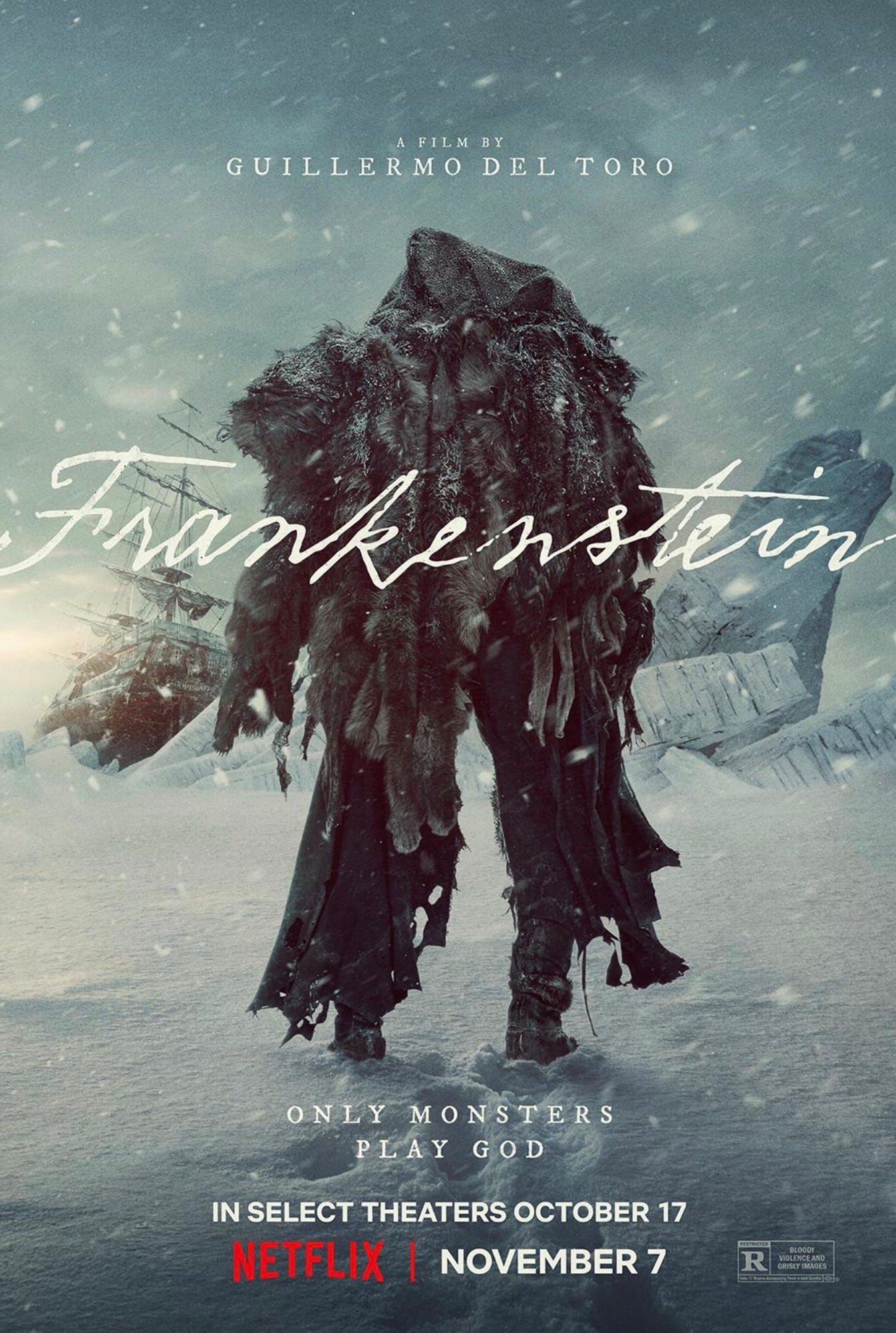
Frankenstein (2025)
The Lightening Found del Toro!

Before I talk about Frankenstein, I have to talk about the noise around it.
We are living through one of those periods when everyone seems desperate to decide what a filmmaker is allowed to touch. One master looks at Netflix and says cinema does not belong there. Another looks at AI and says no real artist should go near it. A third, more seasoned but no less serious, looks at AI and sees a tool that might help him keep reaching for images his body no longer has the stamina to chase. Practical effects, digital cameras, film stock, blue screens, streaming platforms, optical printers, algorithms — every generation redraws the border around purity and then mistakes the border for the art itself.
I am tired of the border. I’m really tired of the border.
Use the tool the work requires. Use the tool you can answer for. Then let the work stand there and tell us whether the bargain was worth it. Because the final encounter does not belong to the tool, or even entirely to the artist. It belongs to the viewer. And there is a real cost in deciding, before a work has touched you, that it is disqualified by the machinery that brought it into being. We talk as though rejecting a film punishes the artist and accepting one rewards them. The deeper risk is personal. If art is one of the ways the soul is broadened, then closing yourself to the moment of impact may cost you more than it costs anyone else.
I carried plenty of resistance into Frankenstein. I have my problems with Guillermo del Toro, with Netflix, with the compromises of streaming, with the public pieties artists build around their own tools and taboos. None of that disappeared. It simply became irrelevant. The film moved through my objections as if they were vapor. And by the time I understood what was happening to me, I was no longer watching a compromised object arrive through an imperfect system. I was watching a masterpiece.
Frankenstein was a bargain. There is no honest way around that. A film of this scale, density, and visual delicacy does not appear because an artist wills it into being. It has to pass through money, platforms, distribution agreements, theatrical windows, compression pipelines, corporate appetite — all the machinery that makes the modern image possible. That machinery is not pure. It never has been.
And the bargain paid off. However I feel about Netflix as the film’s primary home, however much I object to the noise in the image or the smallness of a streaming tile trying to contain something this large, the result is undeniable. The film does not feel diminished by the compromise that delivered it. It feels, against the odds, complete.
That matters. The question is never whether a work of art arrives through immaculate conditions. Almost nothing does. The question is whether the bargain is visible as damage. In Frankenstein, it is not. The circumstances around the film may be conflicted, but the film itself is not. It stands there with the terrible confidence of something that knows what it is.
Del Toro can be a difficult figure for me. I can love him very much and still find myself kept at a distance by some of his work. The Shape of Water, for all its acclaim, remained emotionally remote to me. Others — Pan’s Labyrinth, Hellboy, The Devil’s Backbone — have stayed in me for years. He can be self-conscious about his own strangeness in a way that rubs me wrong, as though the public performance of being Guillermo del Toro sometimes stands between the viewer and the work.
In Frankenstein, that self-consciousness dissolves. The weirdness is no longer a pose. It becomes architecture, costume, body, water, fire, grief. It becomes useful. The film is not del Toro insisting on his own imagination; it is his imagination finally surrendering to a form large enough to hold it.
The production is almost impossibly unified. Visual effects, production design, makeup, costume, music, performance, and color — none of it feels like competing achievement. It feels like one correct choice after another. With this many complications, somebody should surely blow it. Some department should overplay its hand. Textures should turn decorative instead of meaningful. A costume should announce itself as costume. A set should step in front of an actor. It never happens. The elements cooperate. They honor one another. They make a living thing.
Del Toro has always filled the frame with ravishing surfaces — pebbled, satin-smooth, shining, and corrupted. His frames have always belonged to the tactile. But Frankenstein does something more difficult than opulence. Its places feel credible. Not accurate in the museum sense, not period correctness by the numbers, but credible in spirit. The rooms feel haunted by money, science, class, and memory. The world does not seem imagined so much as remembered.
The costumes are central to that achievement. They are not only beautiful. They carry the authority of a design house, the sense that an entire country, an entire class, has been shaped by a common aesthetic intelligence. People do not look outfitted. They look dressed. More than that, they look dressed by the worlds they carry inside them.
Victor’s clothes are one of the film’s slyest jokes. Around him are men in the official costume of power: hats, capes, and polished lapels, the grammar of money and standing. Victor looks as if he has opted out of the uniform and invented a more flattering one. He dresses like a rock star — not literally, psychologically. The clothes feel less like something a costume department placed on him and more like an instruction he has issued to the world: This is Victor. Dress me accordingly.
That is funny, and it is diagnostic. Before he creates the Creature, Victor has already created Victor. He is his own first act of unnatural assembly.
Elizabeth obeys a different law. Victor dresses through will; Elizabeth appears through nature. Her clothes seem to grow from her body the way petals belong to a flower, feathers to a bird, gemstones to the earth. But she is not merely floral. She is gardened. Every time she enters the frame she arrives like a classical English garden given human form: pruned hedges, patterned leaves, peacocks moving through green corridors, colors arranged so carefully they appear preordained. Her beauty is cultivated but alive, designed but never artificial.
Her first entrance is one of the film’s great acts of introduction. Before we properly see her face, we see the blue dress, the feathers, and that necklace. Her shoulders are like porcelain. She is not merely beautiful. She is a vision. She really is. That assessment is not hyperbole. And then del Toro gives her not a grand entrance but a gesture. She is holding a skull — delicately, considering the eye sockets with a tenderness that is almost unnerving. She is not poking at death, not treating it as curiosity or horror. She seems to be contemplating what once lived there, whose eyes those openings once held.
Victor approaches death as something to conquer and take. Most of us think of death as the thing that takes life from us; Victor thinks of it as stolen property, to be reclaimed by force. Elizabeth’s first gesture says otherwise. She holds the skull as though death is not theft but custody. When Victor first moves toward her, with steam in his stride, the attraction has aggression in it — and she pulls the skull toward her chest, almost protectively. It is an instinctive gesture, and it contains the moral argument of the entire film. Victor is coming to take death. Elizabeth draws it back and says, without saying it: no. This is mine to keep. This is my responsibility.
From the beginning, she is the one who knows how to hold death.
The dinner conversation turns that image into argument. Victor’s logic is the oldest and most dangerous logic of genius: if something can be done, why should it not be done? It sounds like philosophy. It is appetite dressed as reason. Elizabeth laughs at him because the idea cannot stand on its own. She does not need to debate him to know that capacity is not permission.
When challenged, she brings up war — devastating, because war is where can has always gone to become obscene. Can we build better weapons? Can we move armies faster? Can we make death more efficient? Of course we can. Human history is full of things we could do and therefore did, and the dead are the receipt. Elizabeth, the keeper of what has gone to rest, hears the bodies underneath the nouns.
Harlander, the financier, has to leave the room at that moment, because she has exposed the hidden contract underneath all this progress. His money comes from organized death. He is an arms dealer. When he and William go, the scene reduces to the two real powers in it: Victor and Elizabeth, the man who would steal death and the garden that keeps it. They are not flirting. They are not sparring. They are negotiating jurisdiction.
The church scene continues the same structure, and it is one of the places where the film becomes almost ridiculously clever without ever turning cheap. Elizabeth comes out of a rain-drenched market street — mud, dripping buildings, crowded bodies, commerce, and decay. She enters the church in what I can only call her moth dress. Victor follows her, because Victor follows. He slips into the confessional and tries to convert sacred privacy into another experiment. He wants access again.
Elizabeth is not fooled. He thinks he is observing her; she has been observing him. He asks whether her sin involves a man, and she gives him just enough rope. Yes — it concerns her fiancé’s brother. He is immediately stimulated by the idea of himself as the subject of sin. Then she names the sin: hatred. When he invites her to continue, she does. He is easy to spot, even on a crowded market street.
The scene is funny because Victor’s vanity is so complete that even insult becomes seduction. But it is also one more scene about jurisdiction. He tries to invade the private chamber of her conscience; she turns the chamber back on him.
Outside the church he asks about the books she has bought. His first guess is romance, because he still cannot imagine her interior life correctly. He sees the beauty, the secrecy, the charge between them, and reduces her mind to the category most flattering to himself. Of course he does. Of course Victor Frankenstein looks at this woman and assumes her mystery is arranged around desire.
She opens the parcel and reveals books on insects — beetles, moths, biology. The correction is devastating because it is quiet. Her mind is not where he placed it. She is studying transformation, all of it. Fragility, metamorphosis, emergence: all the small living systems Victor is too grandiose to respect. He wants to conquer death at the scale of thunder. Elizabeth is studying life at the scale of wings.
This is why her costumes matter so much. She is wearing the subject before she speaks it. The lace on her back, the blue-green garden of the dress, the moth-like wings — all of it belongs not only to her beauty but to her mind.
When Victor and Harlander arrive at the castle, the bargain inside the film becomes literal. Victor does not move through the property like a man considering an offer. He moves through it like a man whose imagination has already signed the contract, placing the machinery in his mind before the handshake occurs. The deal is struck with the obvious weight of a pact with the devil, and the next scene cuts to the gallows.
Living men are about to become dead men, and dead men are about to become Victor’s inventory. That is the shallowness of his morality. He claims to be restoring life, but he cannot be bothered to revere it. Elizabeth treats death as custody. Victor treats death as supply.
This is why I do not think Victor creates life. He does something cruder. He reinstalls animation, and mistakes animation for life the way a technician might mistake a repaired machine for a healed person. The assumption beneath his project is that death is a malfunction. If death is brokenness, reanimation can be framed as repair.
But death is not brokenness. Death may be completion. It may be rest. It may be a state with dignity. Victor’s arrogance is not simply that he crosses a boundary; it is that he misunderstands the boundary. He thinks he is rescuing life from death. He is dragging death out of its proper place and forcing it to suffer consciousness again.
What becomes hardest to watch is not Victor’s violence toward the Creature but his contempt for the conditions he himself created. He keeps this new soul chained to a slab in a basement, far from the world where learning, language, affection, and moral development might actually occur, and then rages at him for developing too slowly. He wants the result of nurture without offering nurture. He wants a mind without giving it experience. He wants humanity without fatherhood.
The most painful expression of this is the Creature’s repetition of Victor’s name. Boots are Victor. The razor is Victor. The room is Victor. He himself is Victor. Victor hears idiocy and mocks it, but the Creature is telling the truth. His entire universe is Victor. That is not stupidity. It is imprinting. It is devotion. It is the first desperate bond between a new life and the first thing it encountered. Victor made himself the whole world, then despised the world for having his name.
Then Elizabeth enters the basement.
She does not find the Creature by science, investigation, force, or male permission. She hears him. She follows a voice. She descends because something below calls to the part of her that already knows how to respond. She is thinly veiled, shielded from the interior of the castle by green, by fabric, by the last fragile membrane between her and the thing Victor has hidden. When she walks into the chamber, the recognition is immediate.
Victor creates proximity through bondage. Elizabeth creates proximity through recognition.
There is no recoil, no disgust, no erotic charge, no sentimental simplification. They move toward each other because something in each recognizes the other’s proper place. It is not quite mother and child. It is not lover and beloved. It is a relationship of nature — bird to sky, fish to ocean, squirrel to tree. The Creature does not belong to the basement. He does not belong to Victor. But he belongs, somehow, in Elizabeth’s field of care.
When they come to their knees facing one another across the narrow stream of water, the film gives us one of those frames that contains the whole argument without needing to explain it. Victor is still talking — still justifying the chains, still insisting the Creature is kept there for his own safety, the old language of captivity dressed as protection. But the camera has stopped believing him. His voice recedes while Elizabeth moves toward the suffering being he has made.
The water separates them, and it joins them. It catches the light and sends it upward onto their faces, so they are illuminated not by Victor’s machines, not by lightning, not by the violent apparatus that dragged life into this body, but by reflection. By water. By something lower, older, quieter. For a moment, the basement is a chapel.
This is cinema in its purest form: a thing of universal importance said without words. Meaning carried by bodies, distance, light, architecture, costume, water, posture, and sometimes silence. Victor remains elsewhere in language. He employs explanation, justification, and control. Elizabeth and the Creature move past language into recognition. The image says what dialogue could only diminish: you are not a specimen. You are not a thing. You are a being. We may know one-another.
The Creature understands, almost immediately, that the moment falls outside the permission of his experience. He looks up to Victor to see whether this happiness is allowed. Victor looks angry, confused, even jealous. The Creature hides his face. That upward glance is one of the film’s most devastating details. It asks: am I allowed to have this? Victor’s face answers: no.
Elizabeth’s response to the Creature is the opposite of Victor’s entire method. She gives access. She lets him examine her fingers, the screen, the hat, that extraordinary violet flowering architecture around her face. Then she removes the obstruction. She makes herself legible to him. She understands that recognition requires access, and she does not fear being known by him.
Later, when she cannot sleep, she returns in a sheer aqua-blue nightgown that seems to carry the memory of the water between them. She revisits him in the costume of the stream. She has seen his suffering, and the knowledge will not let her rest.
There, in the quiet, he is studying a fallen leaf that has drifted into the basement through the water. It may be the clearest proof of his intelligence in the film. Victor is furious because he cannot see intelligence where he expects it — obedience, speech, performance, proof that the experiment has succeeded. But the Creature’s intelligence is already happening in private, in relation to the only piece of the living world that has been allowed to reach him. A leaf comes through the aqueduct. He studies its veins. He recognizes intricacy. He admires form. That is intelligence. More than that, it is wonder.
Victor does not recognize the Creature’s intelligence because he is not looking for intelligence. He is looking for compliance.
Elizabeth asks whether the chains hurt. He does not answer by showing her his injury. He answers by showing her his discovery. He holds up the leaf as a gift, and she receives it the way one receives a drawing from a child: with gratitude, seriousness, tenderness. She holds it to her chest. Victor takes bodies apart and calls it life. The Creature finds a leaf and offers it as love. Elizabeth receives it as sacred.
Then she teaches him her name. Not by striking him, not by forcing him, not by demanding performance, but by placing his chained hand on her throat. It is an almost unthinkable gesture of trust. A powerful hand at a woman’s throat carries a whole history of threat, domination, violation. The film knows that. So when Elizabeth takes his hand and places it there herself, the meaning reverses. The gesture becomes not violence but faith.
She is saying: this is where sound comes from. This is where my name lives. You may know this part of me. I trust you not to harm it.
Victor teaches through force. Elizabeth teaches through contact. Victor demands language as proof. Elizabeth gives language a body.
When Victor accuses her of attraction to the Creature, she rejects the category with venom. Not attraction. Understanding. That correction is one of the film’s keys. Victor cannot conceive of intimacy except as possession, desire, acquisition. He sees a woman giving attention to a body and immediately sexualizes it. Elizabeth is repulsed by the poverty of his imagination. She does not need to possess the Creature to know him. She does not need to desire him to move toward him. She does not need to sentimentalize him to understand his suffering.
What she sees is pain. And if pain is not a sign of intelligence, what is? That is not sentimentality; it is philosophy. Pain means interiority. A mechanism can malfunction, but a being suffers. Victor sees pain as noise in the experiment. Elizabeth sees pain as proof that the experiment has crossed into moral territory.
When Victor finally decides to destroy the Creature, the film makes his test a fraud. He sends Elizabeth and William away so there will be no witness, then douses the castle with petrol. He demands one word, one sign, one reason to spare the being he is already determined to burn. The Creature answers first with the only word Victor has taught him. Then, devastatingly, he says Elizabeth’s name. The word proves everything — memory, attachment, and the expansion of his world beyond Victor. It proves Elizabeth reached him in a way Victor never could.
That is precisely why Victor does not save him. The word does not rescue the Creature. It condemns him, because it proves he is no longer entirely Victor’s.
When Victor lights the castle, the entire film changes — not all at once, not by cutting to a new palette, but physically, almost theatrically. The orange light pushes the blues and greens off the screen from one side of the frame to the other, as though one set were being shoved offstage and another rolled in. The colors of water, of Elizabeth, of garden and insect life and recognition and tenderness and the leaf. All of them are driven away by flame. Orange enters like a verdict.
The fire changes more than the palette. It changes the authority of the film. Until Victor lights the castle, the story belongs largely to him: his wounds, his arrogance, his ambition, his explanation of what happened and why. Even when the film teaches us to distrust him, we are still living inside the architecture of his account. Then the flame enters the basement and drives Elizabeth’s colors from the frame, and the film is no longer Victor’s confession. It becomes the Creature’s testimony.
One half of the film is the story as told by the man who mistook animation for life. The other half belongs to the soul who had to survive being made.
The Creature’s tale changes the meaning of intelligence. Victor wanted intelligence as proof. In the Creature’s account, intelligence develops the way intelligence actually does. He observes. He listens. He learns that words have use. He learns gratitude. He learns that kindness can be answered with kindness. Hidden near the farm, he becomes the family’s spirit of the forest, leaving food, accepting their offerings, performing small acts of practical mercy. He is not yet admitted into human society, but he has found a way to be good in nature.
Then the wolf attack gives him his first philosophy. The hunter does not hate the wolf. The wolf does not hate the hunter. And yet violence becomes inevitable between them. That thought is not savagery; it is understanding. The Creature is learning that the world is not innocent merely because it is natural. The forest that permits generosity also contains hunger, territory, and collision. Goodness is real, but so is violence. Mercy is real, but so are teeth. To deny that is its own kind of arrogance.
By the time the Creature returns to Victor, he has become the one thing Victor refused to imagine: an interior life capable of speech, love, analysis, and rage. Also, not lastly, grief. The miracle is not that he speaks. The miracle would have been Victor actually listening.
And Victor still cannot.
Before the wedding, Victor tries once more to lie his way into nobility. He comes to Elizabeth offering blessing, renunciation, maturity — all the ceremonial phrases by which people disguise appetite as love. Elizabeth will not let him have the performance. On her wedding day, she asks for the one courtesy he cannot give: no more lies.
The Creature’s arrival immediately afterward lands with such force because Victor has just been seen accurately by Elizabeth, and then the being he tried to destroy steps out of the dark. For one instant, the truth of him is everywhere. Still he cannot receive it. His first instinct is vanity. He interprets the Creature’s survival as tribute. Even the intelligence required to find him becomes, in Victor’s mind, evidence of Victor.
This is why William’s final judgment matters. William is the plainest figure in the film, the least imaginative person in the room, the socially decent brother and fiancé who has mostly moved through the story as a neutral witness. Elizabeth has vision. The Creature has suffering. Victor has genius corrupted by self-mythology. Harlander has money and moral rot. William has almost no embellishment at all. He is ordinary, and that ordinariness gives his verdict force.
When William tells Victor what he is, the moral reversal finally attaches itself to the right body. Monstrosity is not appearance. It is conduct. The Creature may be grotesque to look at, but Victor is grotesque in action. And Victor proves the verdict almost immediately by picking up a shotgun and hunting the being he made. No more science. No more philosophy. No more claims of restoration. Just a frightened man with a weapon, pursuing the soul whose existence he refuses to answer for.
Elizabeth dies in perfect recognition. Her final request to the Creature completes the strange, sacred belonging between them: she asks him to take her with him. When he lifts her in her bloodied wedding dress and carries her through the wedding party, the whole film turns to ritual. The rose petals falling around them were meant to celebrate a union. Instead they accompany a passage. The garden sheds itself around her as she leaves the world.
To be lost and to be found — that is the span of love. And in its brevity is tragedy. Elizabeth and the Creature do not get a life together, not in any ordinary sense. They get recognition. A leaf offered and received, a hand placed on a throat, a name learned, a face trusted, a body carried through falling petals. It is almost nothing by the measurements of a life, and everything by the measurements of a soul.
What happens between them has been made eternal — not by duration, but by image. The film cannot give them time, so it gives them form. It preserves the encounter the way cinema preserves the things life cannot keep: a look, a gesture, a body in light, a moment when one being is finally found by another. Love does not save him. It finds him. And for this film, that is both the miracle and the wound.
By the end, Frankenstein no longer feels like a film speaking in ordinary dialogue. It feels like opera passing through cinema, or ballet made out of grief. The dialogue often has the scale of opera, and that is dangerous. Lines that could collapse into costume-pageant thunder do not collapse here, because the film has built a world large enough to contain them. By the time the Creature declares himself Victor’s master, the language has become the proper size of the wound.
The same is true of the music. Alexandre Desplat’s score does not merely underline emotion; it gives the film a dance logic. The assembly of machinery reads like choreography. Characters do not simply cross rooms. They enter, glide, recoil, descend, and finally present themselves. The wedding procession, the basement encounters, the staircases, the final deathbed — all of it feels staged as movement before it resolves as drama.
This is not ornament. The film is about bodies: bodies assembled, bodies dressed, bodies restrained, bodies recognized, bodies carried, bodies returned. Of course it moves like ballet. Movement is part of its thinking.
At the end, Victor finally sees his life for what it was — too late for the knowledge to save anyone. The Creature sits beside him, immense in moral and physical scale, like a god beside a small woodland animal. All Victor’s storm, genius, arrogance, and theatrical self-conception have collapsed into a dying body. The one he called a thing has become the larger being in the room.
What the Creature offers is not cheap forgiveness. It is mercy from the wound itself. Elizabeth could understand Victor, but it was not hers to absolve him. She represented the moral order he violated: nature, death, custody, the garden. The Creature is the offended one. If forgiveness can come from anywhere, it has to come from him.
And what he gives Victor is death returned gently. Victor spent his life trying to steal from death. The Creature’s final act is to return Victor to it as peace.
If the ideas in Frankenstein had merely passed through the ordinary development process, I do not think they could have landed this way. A committee might have preserved the mechanics: make it operatic, make Victor arrogant, make the Creature sympathetic, give Elizabeth moral force, divide the story between creator and creation. But the mechanics are not the miracle. The miracle is the ripeness of the thing. These ideas feel as though they have incubated inside del Toro for decades, gathering pressure, imagery, language, texture, grief, and patience until they were finally ready to become a film.
That is why the operatic register works. It has not been imposed on the material as a concept. It has grown from within it. The lines that should collapse into melodrama do not, because the world around them was built to hold them. The costumes, the bodies, the music, the architecture, the fire, the water, the leaf, the throat, the petals — all of it seems to have been waiting for the same hour.
Everything before this begins to look, unfairly but irresistibly, like a workshop for this moment. Not because the earlier films are diminished by Frankenstein, but because Frankenstein gathers the images that have haunted del Toro for decades and finally gives them their fullest body. The burning institution, the wounded monster, the childlike soul trapped in a frightening form, the woman who sees what the world refuses to see, the machinery of death and rebirth, the gothic architecture lit from within — all of it has been there before. Here it stops feeling like recurrence and starts feeling like arrival.
I do not know what del Toro does after this. I do not mean that as a prediction or a threat. I mean that this particular vocabulary — these obsessions, these shapes, these wounds, these beautiful ruined rooms — may never have more force than it has here.
Frankenstein feels like the place where his ghosts have finally found the body they were looking for.