
Hamnet (2025)
All Arise!

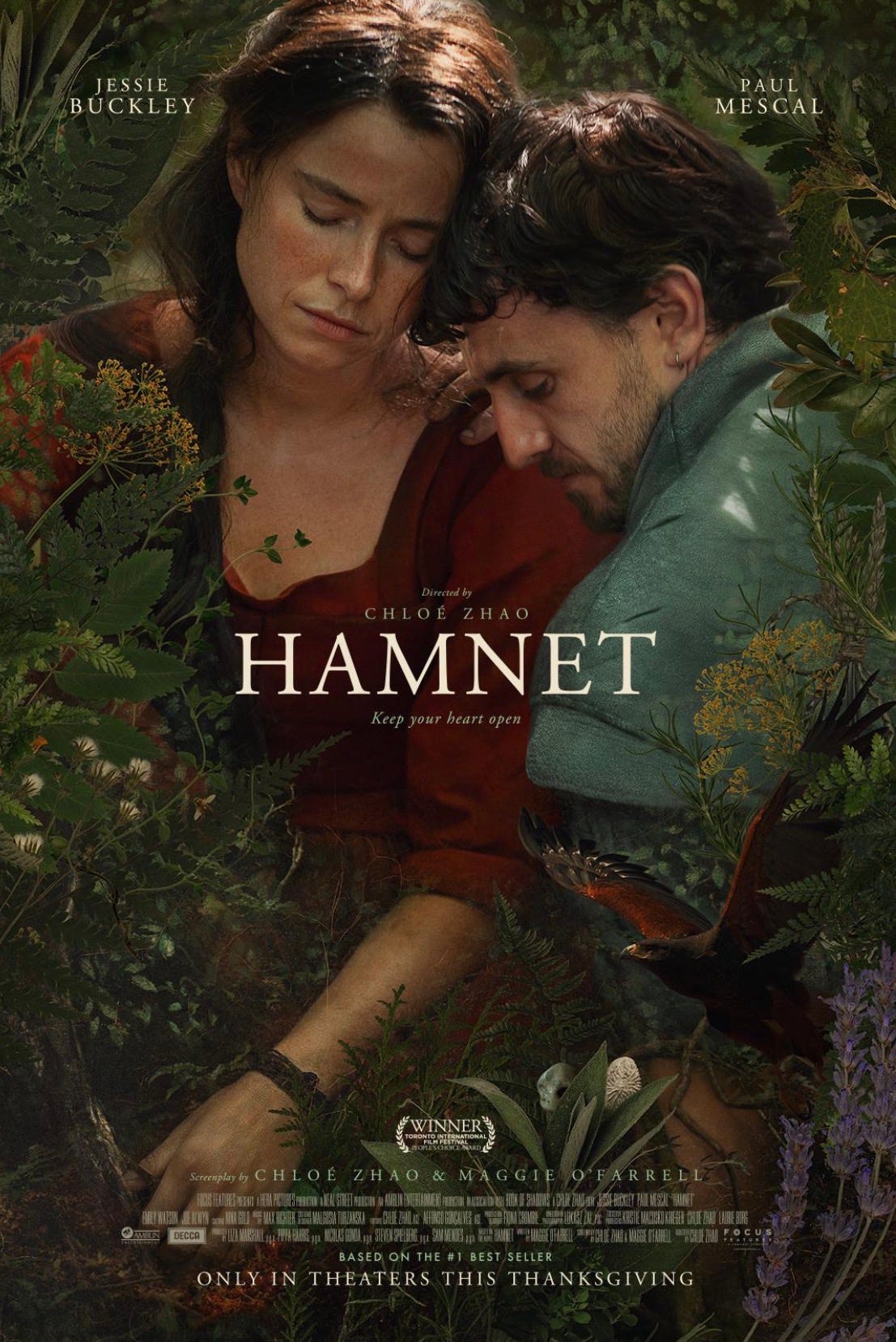
There are moments in Hamnet when the ordinary vocabulary of response becomes inadequate. I love many films, and still, there are words I almost never touch. But Hamnet is one of the few films that seems to have earned those words back. So, allow me to proceed… The film does not ask for tears by announcing tragedy. It builds such a dense continuity of joy, death, play, and family that feeling arrives before interpretation can capture it. One does not admire the scene from a distance. One must recover from it.
Hamnet is not merely moving because it is sad. Sadness is cheaply obtained in movies. Dead children, absent fathers and mothers, marriages under pressure: these are not in themselves artistic achievements. What matters is the precision with which the film builds the conditions under which grief can be shared, and finally transformed into theater without becoming smaller. The film does not treat grief as material to be harvested by genius. It treats grief as a world to be entered, and perhaps only survived when it has been given a form large enough to hold more than one person at a time.
A recent kind of reading of the film treats Shakespeare’s absence as an evasion, as though the film fails by refusing to enter the furnace of his genius directly. Another common reading treats it as a story about the toll greatness takes on a family, genius on one side and domestic suffering on the other. Both readings are tempting, and both seem to me to miss the film’s line of sight almost completely. Hamnet does not build Shakespeare from the inside out. It builds the negative space around him: Agnes, the forest, the theater, the dead child, and finally the face in the crowd where the work arrives. The film refuses to show the spark as an event inside Shakespeare because that would cheapen it. It shows the struggle with language and then language as it lands, but not the mysterious arrival in him. The spark remains a trajectory. The genius are the spaces in the cut.
That refusal changes the meaning of arrival. In another biographical film, creation may arrive when the artist sits at the desk, when the hand moves, when the famous phrase appears. Hamnet understands that this is not where the real arrival occurs. The arrival happens in reception. It happens when Agnes hears the name. When the play reaches the person for whom it has been made. The climax is not Shakespeare writing Hamlet. It is Hamlet arriving in Agnes’s expression.
The first seconds of the film already contain its grammar. The camera moves down through a thinning branch, across leaves that seem to sit like small platforms in the air, and the sensation is recognizably physical: the strange, suspended architecture of wild growth, the way nature sometimes appears to have built itself into ledges, and thresholds. The movement brings us to Agnes on the forest floor, curled inside the exposed root system like a child inside the body. The image is so deliberate that it nearly announces itself: Agnes is not merely in the forest. She is held by it, shaped by it, almost born from it.
But the following scene immediately complicates any sentimental reading of that birthright. Her companion is a hawk, a creature of violence, and Agnes does not flinch from what it is. She feeds it flesh and delights in its nature. This is not a soft pastoral vision of the natural world. Agnes knows that nature is predatory, exacting, beautiful, and dangerous all at once. She is not a flower-crowned woodland fantasy. She is someone who understands that the world feeds on itself.
That matters later because the death of Hamnet is the event that breaks the difference between knowing nature and surviving what nature does. Agnes may understand death as part of the order of the world. She may know that living things fail and disappear. But that knowledge has not yet been asked to include the body of her own child. She knows the law of nature before she is forced to pay its full price. Hamnet is devastating because the film never mocks her knowledge, and never suggests that knowledge should have protected her. Wisdom may teach us the shape of loss. It cannot keep loss from breaking the person who knows it.
The sound design understands this before the story announces it. The trees do not simply sway in the wind; they snap, scrape, and whisper against one another. Even when rain is not visible, the world often sounds as if rain is falling somewhere just beyond sight. At first that sound seems native to the forest, a way of making Agnes’s world alive, and alert. But the sound does not remain there. It follows the film into town, onto the road, to the space outside Shakespeare’s house, and eventually into the house itself. By the time Hamnet runs up to the loft to wake Judith, saying they must hurry before it starts raining, the room already sounds as if a downpour has begun inside it. The soundtrack knows more than the child does. He speaks of rain as future weather, but the film has already made it present.
The effect is more than atmospheric. It prevents the film from dividing its world too neatly. A lesser film might give us town and country as opposites: nature versus civilization, body versus language, witchcraft versus social order. Hamnet is too intelligent for that. The town is not a metropolis sealed against nature. It is a human arrangement inside mud, disease, and death. The forest is always just over the shoulder. The outside enters the house long before death does, or rather the sound tells us that death and weather and nature were never truly outside in the first place. Human speech is not alone in the room.
This is why Agnes and Shakespeare are not Tarzan and Jane. She is not nature in opposition to his civilization, and he is not civilization arriving to interpret nature. They are both porous. They are both made of family, shame, desire, language, and fear. Agnes knows the forest, the herbs, and inherited powers of her mother’s world. Shakespeare knows story, rhythm, the pressure and release of words. But neither knowledge is complete by itself, and neither belongs to a sealed kingdom. Their romance is not the civilized man educating the wild woman into language, or the wild woman returning the man of words to animal vitality. It is the two of them discovering that their forms of knowledge can recognize each other.
The first sight of Shakespeare is comic because it places the greatest writer in the English language in the wrong room. If one were ever going to risk calling someone the greatest writer in human history, Shakespeare would be the safest candidate, and yet the film first gives him to us as what may be the worst schoolmaster in Warwickshire. He is not merely impatient with the children. He is barely there at all, staring out the window, snorting at the life beyond the room, enduring his employment as though it were a minor imprisonment. The joke is even more scandalous than professional incompetence. The children are reciting their lessons while he stares out the window toward Agnes, and then he leaves them chanting obediently into the air while he runs after her. Imagine the parent-teacher conference. Your child’s tutor, William Shakespeare, has abandoned the lesson because desire has walked past the window.
The joke carries the film’s larger argument. The schoolroom is language as duty: recitation, and correction. Agnes is something else entirely: mystery, and danger. Shakespeare abandons the respectable use of words because something outside the window has begun to call him toward their source.
The barn scene continues the film’s quiet campaign against the marble-bust version of Shakespeare. He is not introduced as polished, or above the body. He is a young man so overcome by desire that he can barely account for himself. There is a dry joke in this. The future author of Romeo and Juliet follows a woman into a barn and cannot quite say why he is there. He has not yet written the book on making a pass; in this moment, he can barely manage one.
Agnes asks what brings him to the garden, and he flusters. He says he saw her with her bird, and she corrects him: it is a hawk. She does not weaponize the knowledge. She simply knows the world she lives in. The bird has a name, and a purpose. Shakespeare, for all that he will become, is still learning how to see what is in front of him.
The hawk is also a rehearsal for Agnes. When Shakespeare first moves toward it, Agnes warns him that it does not know him. The line belongs to the bird, but it also belongs to her. Shakespeare approaches cautiously, without presuming welcome, and when the hawk jabs at him, he does not take offense. He jumps, but he does not recoil. He laughs with real delight, as though the creature has become more beautiful by revealing its danger. Agnes notices. When she says the hawk likes him, the sentence is doing double work. The hawk has tested him first. Shakespeare has passed not by mastering the animal, but by accepting its nature. He can be startled without becoming cruel. He can approach wildness without needing to tame it.
That same approach structures the early exchanges between Agnes and Shakespeare. Her skepticism is not merely intellectual. It is animal caution. She has been looked upon by society as strange, and possibly dangerous, and so she has learned to return that posture to the world. But her suspicion is not closed; it is alert. She tests the air around Shakespeare. She lets him come nearer by increments: word by word, glance by glance, pause by pause. The scene plays less like conventional courtship than approach. He is a man of words moving toward someone who belongs to the forest, and she receives him as a wild creature might receive a human hand: not with surrender, but with careful, frightened attention. He may come closer, but only through form.
That is why her request for a story matters. When Agnes asks why he has come, Shakespeare stumbles. The joke sharpens: the man of words has no words. Agnes sees the contradiction and does not let him escape it. She teases him with just enough sarcasm to draw blood. Is he not, after all, the master tutor? But the sarcasm is not dismissal. It is an untamed invitation. It’s also a test. If speaking plainly is difficult, then tell me a story. If words are what you are, then use them. She is not reverent before him, not yet. Her attention is available, but uncertain. Shakespeare does not become himself by producing language in isolation. He becomes himself before a listener who matters.
He asks what kind of story she wants, and after a moment she says: one that moves him. That answer changes the scene. She is not asking to be entertained, nor is she asking to be instructed. She is asking him to reveal himself by indirection. When he offers Orpheus, she does not answer whether she knows the story. The point is not her familiarity with the myth. She wants to hear what happens to him when he tells it. How much feeling is there under the tutor? How much wildness under his words? Can the world he comes from — books, and social duty — survive contact with hers: root, hawk, caution?
As soon as Shakespeare begins the story of Orpheus, something in the scene changes. He does not begin with literary pedigree. He begins with music and its effect on the natural world: rocks, trees, and beasts. They are all moved by song. Agnes almost immediately lowers herself to the earth and settles in, because he has found her language. He has not pulled her into the classroom; he has brought language into the forest. This is the first true flare of Shakespeare in the film, not genius as public monument. He locates, instinctively and at once, the place where the story can enter the person listening to it. That is what separates him from mere eloquence. He does not only possess words. He feels where words must land.
That is the miracle of Shakespeare in a larger sense. It is not that everyone understands every word. Often we don’t. The language is distant from us, formally strange, carried across centuries from another system of speech. And yet, again and again, something lands with impossible immediacy. You can be sitting beside strangers, watching a play written in a language adjacent to your own but not quite yours, and suddenly everyone in the room feels the same recognition pass through them. The recognition of experience. I know that thought. I know that turn of the heart. Shakespeare’s greatness is not merely that he possessed words. It is that he knew where words had to land.
The story he chooses is already their story, though neither of them can know it yet. Orpheus falls in love with a creature of the natural world, and that beloved is poisoned, taken from him. He descends into the underworld, not to save her. Save is too available a word for a myth built around failure. He goes to retrieve what death has no right to keep. He puts himself in danger for love, crosses the border no living person is meant to cross, and discovers that music can move stones, trees, beasts, and gods alike, but still may not be able to undo the finality of loss. In the forest, Shakespeare tells the story as courtship. In retrospect, the film has already given us the form of his life: love, descent, death, and the terrible limit of song.
The condition placed on Orpheus is almost impossibly cruel: he may lead Eurydice back to the world of the living, but he cannot look behind him. He must trust that she follows even though he cannot hear her footsteps. The story requires faith, self-control, and a love that does not demand proof. It is also the film’s first description of grief. To lose someone is to keep walking while listening for a footfall that does not come. Love wants to turn around. It wants evidence. But the dead cannot be brought back by looking, and they cannot be recovered by force. In telling Agnes the story of Orpheus, Shakespeare is not only courting her. Without knowing it, he is speaking the law that will later govern their sorrow: art may lead love to the threshold, but it cannot make death give back what it has taken.
The scene that follows reverses the schoolroom. Shakespeare, the failed master tutor, now sits as Agnes crushes herbs, speaking to them as though naming their virtues into action. She is teaching him, though nothing about the lesson resembles instruction as his world recognizes it. Her knowledge is tactile, medicinal, half witchery and half household practice. She makes a compound and places it on his head, and the conversation that follows becomes disarmingly direct. He asks whether it is true that when she touches someone she can see the entirety of them. Not the entirety, she answers, and the simplicity of the answer is almost shocking. The scene keeps stripping away the ordinary evasions of speech. Question, answer. Question, answer. Each exchange moves them farther from social convention and closer to something cleaner.
When he asks what she saw in him, she does not say greatness. She says she saw a landscape. That answer is perfect because it refuses to turn Shakespeare into a statue. He is not yet the author of the plays. He is terrain, as she puts it: caves, cliffs, wild places, undiscovered countries. The first explicit shimmer of Shakespearean language enters the film not as quotation but as geography. Because Agnes has already been established as someone whose speech grows naturally out of earth, and body, the phrase does not feel like a clever insertion or a prophetic trick. It lands as plainly as a fact of nature. She looks at him and sees not a reputation, but a world.
That is the film’s method with Shakespearean recognition. It begins dropping them, and then never really stops. But they do not feel like Easter eggs or scholarly winks. They surface more like bubbles in a stirred pot. Agnes grinds herbs on stone, and one thinks of the poisons and apothecaries to come. She sees caves, cliff tops, and undiscovered countries. The marriage scene carries the pressure of Romeo and Juliet without reducing itself to a quotation. Two young people stand before the necessary holy witness, joined under the pressure of desire, pregnancy, and a world that has not yet made room for them. It is not a quotation from Romeo and Juliet, exactly. It is the condition from which Romeo and Juliet might later become imaginable. The plays are not being quoted by the film so much as overheard before their birth.
The household scenes that surround this courtship quietly bind Agnes and Shakespeare before either of them can name what they are to each other. Agnes returns to a home where her difference has been converted into shame, and Shakespeare returns late to a family meal where his father’s disappointment waits for him like a sentence already passed. The violence is not identical. In Agnes’s house it is mostly verbal, and atmospheric: the steady pressure of contempt. In Shakespeare’s it is more bluntly patriarchal, bound up with labor, humiliation, and the father’s hand. But the shape is the same. Each household has decided that one of its children is a problem.
What keeps both scenes from becoming unbearable is the presence of a mediator. Agnes has Bartholomew. Shakespeare has his mother. Neither can save the room, but each provides a small human counterweight, just enough tenderness or restraint to keep the family structure from collapsing into open cruelty. These figures are not solutions. They are pressure valves. And perhaps that is part of what Agnes and Shakespeare recognize in each other so quickly. Their attraction is not merely erotic, though it is certainly that. It is also the recognition of one pressured creature by another. They have both been made strange inside houses too narrow to contain them.
The two household scenes also perform a subtler exchange of information. In Agnes’s home, the conversation turns toward Shakespeare; in Shakespeare’s home, the conversation turns toward Agnes. After meeting one another first as bodies in charged proximity, each now learns the other’s coordinates. They sit inside their respective family rooms and hear the other person described from the outside: family reputation, occupation, rumor, where they may be found, and what type of disturbance they represent.
The structure is elegant because neither family intends to bring them closer. The talk is suspicious, and belittling. Agnes is converted into a problem by Shakespeare’s household; Shakespeare is converted into a problem by hers. But the lovers hear something else inside the reduction. The families try to make each of them smaller, and instead provide a map. What is meant as warning and shame becomes attraction. They are learning one another through the very rooms that cannot understand them.
This matters because the pregnancy scene is the first time the private language between Agnes and Shakespeare is forced into public. Until now, their directness has lived in charged spaces: the barn, the forest, the story of Orpheus. But now Agnes sits in his parents’ house, having already spoken the fact of her pregnancy before he arrives. The room immediately reaches for the oldest explanation available to it. She has bewitched him. The strange woman has corrupted the son. The forest has entered the house and it is named as danger.
What makes the scene uncanny is that Agnes and Shakespeare do not behave according to the terror of the situation. Shakespeare enters with trepidation, but not shame. He doesn’t look at Agnes as though she has betrayed him by coming there. He moves toward the fact of her. And Agnes, having come without asking permission, has already placed enormous trust in him. She knows, or believes she knows, that once the truth is made public, he will not abandon it. The two of them exchange small smiles in the middle of the family’s alarm, smiles the parents can only read as defiance. But they are more intimate than defiant. They are the first public form of the private language the film has been building between them. The room sees scandal. They see recognition.
Bartholomew is one of the film’s great quiet blessings. His resistance to the marriage is not cruelty. It is practical love. From where he stands, Shakespeare is a terrible bet: a pale man of words, attached to a troubled family, with no visible future solid enough to hold Agnes and a child. But Bartholomew does not answer fear with authority. He does not forbid, or shake sense into her. He asks. And because he asks, Agnes can answer from the deepest part of herself. She tells him what she saw when she touched Shakespeare’s hand: more inside him than she has ever seen in any person.
The scene becomes beautiful because it treats brother and sister as equals. They return together to their mother’s old instruction for uncertainty: keep the heart open. In lesser hands, the phrase might collapse into sentiment. Here it carries the weight of inheritance. They have carried it from childhood into adult danger. And when Agnes says Shakespeare loves her not for who she should be but for who she is, Bartholomew hears the one argument that matters. He may doubt Shakespeare’s prospects, but he cannot dismiss a man who sees his sister without trying to reduce her. So he gives the blessing the rest of the world withholds.
One of the film’s quiet mercies is that it does not ask us to purchase Agnes’s dignity with contempt for everyone else. It does not organize morality by gender. It lets women be wise, frightened, generous, suspicious, practical, and loving. It lets men be violent, tender, decent, selfish, and large-hearted. Nobody keeps the moral franchise. The film understands patriarchy as a structure, but it does not turn every man into patriarchy or every woman into innocence. Its moral imagination is larger than grievance.
That is why Mary Shakespeare becomes so important. The later birth scene is one of the film’s clearest examples of its refusal to sort virtue too simply. Mary has not always been generous to Agnes, and the household has often treated her as scandal, or witchcraft brought indoors. But when Agnes goes into labor during a storm, Mary becomes the person the moment requires. She refuses to let Agnes flee to the forest, not because the forest is beneath her, but because the river has breached and the weather has made the outside world unsafe. Her authority is severe, but it is not empty. She is taking responsibility for the life.
What makes the scene moving is that Mary does not try to win an argument about whose world is better. She gives Agnes the fact that might steady her. Shakespeare was born in this room. He took his first breath here. The man Agnes loves entered the world under this same roof, and that becomes proof of concept. The room may not be Agnes’s chosen chamber. It may not be the forest, or the place where her body wanted to go. But it has already held the arrival of life. It has already delivered the man she loves. In that moment, Mary’s love is not soft, but it is real. She tells Agnes, in the only language the emergency allows: you can do this, and you will.
The birth of the twins then becomes almost impossible to contain because it refuses to make anyone small. The women around Agnes are not acting in bad faith when they try to bring her the living child. Their gesture is loving, reasonable, and also incomplete. They are doing what human beings do when grief threatens to swallow a room: they bring life toward it. They try to say, without cruelty, this child breathes, this child is alive, hold this one, come back to us. But Agnes understands something the room can’t yet hold. The lost child is also real. The living child does not cancel the dead one. She insists that the baby be placed in her arms because even a life that seems to have ended must still be received by the mother.
Mary’s anguish keeps the scene from becoming an argument between wisdom and ignorance. She winces with Agnes. She feels the grief strike the room and pass through her own face. Everyone is trying to be as large as the moment requires, and the moment is larger than everyone. Then the baby returns, but not with the usual theatrical thunder of a miracle. Life does not blast back into the body. It uncurls. The event opens slowly, like parchment releasing itself from a roll. The restraint is what makes it devastating. The film does not announce that life has defeated death. It shows, for one impossible moment, death loosening its grip.
The other birth scene has the film’s peculiar comic grace. Agnes wakes beside Shakespeare, heavily pregnant, and understands that the time has come. She does not wake him into panic. She goes to the table, takes his quill, leaves a note, and walks into the forest with the hawk. The gesture is pure Agnes: the body announces its task, and she goes where the task belongs. Even the borrowed quill feels right. Shakespeare’s instrument of language is used for the most practical sentence imaginable. I have gone to give birth.
The film returns her to the same rooted place where courtship, story, and desire first gathered around them, but now the image becomes literal. The forest is not metaphor only. It is chamber, witness, birthplace. When Shakespeare and Bartholomew arrive, the danger has already been moved aside. Mother and child lie peacefully on the earth, and the scene becomes less a crisis than a small, beautifully coordinated act of care. Bartholomew does the most sensible thing in the world: he takes the baby from Agnes and places the child in the father’s arms, then turns back to tend to his sister. No one is jealous of the role given to another. Everyone knows what the moment requires.
And then Agnes, who has just done the impossible alone in the forest, reaches out to comfort Shakespeare. She pats him on the shoulder with the air of someone reassuring a bystander after the fire has been put out. It is funny because it is so exactly reversed. He has arrived to witness the miracle, but she has already completed the work. The ordeal belongs to her, and yet she is the one telling him, without making a fuss, that everything is all right.
But even there, the film refuses to let birth appear without death standing beside it. Shakespeare stands holding the newborn child, and for a moment the camera shifts behind and above him, placing father and baby before a great hole in the earth. The music darkens for a breath, then the film cuts away. It is almost subliminal, but it changes everything. The same earth that has held Agnes like a womb, received her desire, and served as the chamber of birth now opens as something else: grave, mouth, underworld. The film does not allow birth to remain innocent of death. It does not spoil the joy, but it places mortality inside the frame before anyone in the scene can know why.
Many films reveal truth by event: something happens, and the meaning arrives as consequence. Hamnet often works differently. It embeds instruction throughout itself. The scenes do not simply advance the narrative; they teach us the terms of the world before the narrative asks us to survive them. The hawk teaches approach and loss. Orpheus teaches descent. The births teach the proximity of life and death. The children’s games teach theater as consent. The fireside conversation teaches the scale of parental fear in a world where survival is never assumed. These are not lessons delivered from outside the drama. They are household knowledge, and bodily knowledge, By the time tragedy arrives, the film has already trained us in the language by which it will be felt.
This is not ordinary foreshadowing. Foreshadowing usually says that something is coming. Hamnet does something more terrible and exact. It says: this, very specifically, is coming. Practice.
Again and again, the world seems to tell Agnes and Shakespeare exactly what is coming, not in riddles but in forms: Orpheus, the death of the hawk, the births, the puppet show with its boat, skeleton, and angel of death. Creation keeps calling rehearsal time. Brace yourself, it seems to say. Not because something unexpected will happen, but because this will happen. The specificity is what makes the structure so devastating. The film is not hiding its tragedy. It is practicing it in front of us, with such tenderness and exactness that by the time the real thing arrives, we understand that preparation was never protection. It was only a language for what could not be survived without one.
The children’s play is one of the film’s most beautiful forms of that instruction. Hamnet and Judith exchange clothes and identities. Susanna notices at once, and Agnes gently tells her to play along. Then Will enters, sees the same thing, pauses just long enough for us to know he has understood it, and makes the same decision. He does not correct them. He joins the audience. The children sit there peeling apples and hamming it up, and the family gives them the only gift theater ever really asks from us: consent.
The scene is domestic, funny, and almost unbearably hopeful. It understands that play is not trivial to children. It is one of the first ways they make a world and ask others to live inside it with them. The first theater in Hamnet is not the Globe. It is a household room where children put on the wrong clothes, speak the wrong names, and are lovingly allowed to be believed. That permission is everything. Shakespeare’s later art will depend on the same compact: we all see the disguise, and we agree not to destroy it by saying so.
The film’s happiness matters because it is not only bait for sorrow. The family scenes are not moving because they are doomed. They are moving because they are alive. That distinction matters. Hamnet does not treat happiness as a trap laid for tragedy. The joy has its own reality, independent of the sorrow that will later arrive. When the children become Shakespeare’s little acting troupe, first inside the house and then out in the garden, the film is not merely planting future pain. It is showing a household in possession of play. The children invent roles, exchange names, perform themselves into other shapes, and the adults give them the dignity of belief. Will and Agnes do not puncture the illusion by explaining it. They allow for it.
The death of the hawk becomes another embedded rehearsal. Agnes has a competence in death. She knows how to make it part of a ritual. She does not hide it from the children, and she does not sentimentalize it. She brings the family around it. The dead companion becomes a shared event, something that can be witnessed, named, and honored. That knowledge is real. The film does not mock it. But later, when death enters the house and takes Hamnet, the same knowledge will be asked to bear more than it can bear.
A few minutes later, the film embeds another lesson in ordinary attention. Agnes sees that the bees have moved to the top of the tree. The colony is displaced, and unsettled. Something has upset them, and Bartholomew receives the statement seriously. The scene does not produce a consequence in the usual narrative way. No one is stung; no disaster immediately follows. Its purpose is instructive. It shows us a household that must read the world before the world explains itself. These people do not live by the instruments we have now. They have weather, insects, memory, season, sound, and smell. Agnes tells Bartholomew to keep the children inside because the bees are wrong, and if the bees are wrong, the day is wrong. Whether the conclusion would satisfy modern science is beside the point. The film is showing the practical intelligence of a life lived by signs.
London receives the same treatment. The ordinary absent-artist story would make London look like temptation: ambition, escape, or self-invention. And of course it is those things too. But the film immediately places Will inside poverty, disease, public death, and the constant proximity of collapse. He is not leaving the dangerous real world for an artistic fantasy. He is moving from one threatened world into another.
When Will sits near the water and tosses a scrap of food to a puppy, the small tenderness opens onto a harsher geography: the dog returns to its owners, vagrants camped near the shore, and Will walks past them toward a city where bodies are being carried away in bags. The scene is instructive rather than dramatic. It teaches us that he has not left danger behind. He has entered another form of it. Stratford has childbirth, family violence, illness, and the fragility of children. London has crowding, poverty, bad air, and disease. The city is not a shining alternative to the household. It is also a threatened organism. The dangers of this world are not waiting to detonate. They have already detonated.
Then what first looks like period texture turns out to be another embedded instruction. In London, Will watches a puppet play through scrim and light: a monkey drops onto a box, a man is startled, the two move toward one another, the monkey offers the man a box, and soon they are joined in passage, traveling by boat across the sea. On the far side wait three children, two girls and a boy, and behind them stands death, with an angel hovering above. The image is so plain in retrospect that it feels almost impossible to have missed, but that is how the film works. It lets meaning pass first as sensation, then reveals the architecture underneath. The puppet show is not decoration. It is theater as omen, the family rendered in miniature before death steps into the house. The film’s efficiency is almost shocking: what looks like atmosphere is never just atmosphere.
What is remarkable is that the whole family seems to understand, in its own way, what it has on its hands. When Will says he leaves for London tomorrow, Hamnet asks whether he is taking them with him this time. Not yet, Will says, though he needs to. And the child answers, simply, that he understands. The moment is small, but it reveals the emotional culture of the household. Agnes has not weaponized Will’s absence against him, and she has not taught the children to do so. She has done the opposite. She has helped demilitarize the family around his calling.
The cost is real: she carries the labor, the loneliness, the weight of the house and children while he goes where the work is. But she also knows what she saw in him. This is the man who contained more than anyone she had ever touched. So she does not merely permit his becoming; she participates in it, and somehow teaches the children to understand it as part of the family’s life rather than an abandonment of it. His leaving is not treated as the opposite of family. The family has made room for his leaving as part of what the family is.
The leaving scene does something rare. It does not pretend that Will’s departure costs nothing, but it also refuses the simple charge of abandonment. He wears the knowledge of that charge in his body. He knows what it looks like: a man leaving his wife with the children, a father turning toward work while the household remains behind. But when he lowers himself to speak with Hamnet, he does not offer the banal cruelty of asking the boy to become the man of the house. He gives him the instruction that actually matters. Stay away from my father. I need to know you will be safe. In the act of leaving, Will puts protection first. He cannot be present, so he names the danger his absence might expose. The scene turns departure into responsibility, not by excusing the absence, but by showing the care that survives inside it.
Then the scene wraps itself in joy. Will asks Hamnet the kind of question any loving father might ask: will you be brave while I am gone? The exchange begins in tenderness and turns into play. Will asks again, then again, until the boy laughs and answers with delighted certainty that he will be brave. The moment feels like a small rupture of joy, a father and son turning separation into a game they can survive. But the film does not forget the promise.
Later, when illness comes for Judith and Hamnet meets death in her place, the scene returns with devastating clarity. He is being brave while his father is gone. Not in the way Will meant, not in any way a parent could intend, but with the absolute logic of a child who has been given a promise and keeps it. Will meant endurance. Hamnet receives it as sacrifice.
The moment Will rounds the corner, the film cuts to Hamnet crying in the garden. He has been brave in front of his father, but bravery cannot hold once his father is gone. Agnes finds him, and he composes himself almost at once. When she takes his hand, he asks what she sees, because he knows that his mother sees. Her answer feels less like prophecy than mercy. She tells him she sees him in the playhouse with his father. When he asks what he is doing there, she does not dictate the vision. She gives it back to him: what would you like to do? Hamnet says he wants to be a player with a sword, and Agnes asks him to show her. So he performs the swordplay Will has already taught him. Even in absence, the father remains in the child’s body. Then Agnes asks who will win, and Hamnet lifts himself into the answer: he shall win, of course. For one radiant moment, the film gives the child a future in which bravery is play, danger has a shape, and the sword is enough.
The illness scene begins under the logic of misdirection. Judith is the sick child. Judith is the visible crisis. Judith is the one being tended, feared for, and gathered around. So when Hamnet appears above her, separated in focus from the softened figures below, we read the image as concern. Only later does its meaning become brutal in its clarity. The film was not hinting that death was near. It was showing us where death would go. Its exactness could only become legible afterward.
While Agnes and Mary labor over Judith — crushing herbs, feeding her, cooling her, loving her through the body — Hamnet watches. The film cuts to his face, and the child is not simply frightened. He is thinking. He bites his lip with the terrible concentration of someone trying to understand what courage now requires. His father has asked him to be brave while he is gone, and Hamnet has promised that he will. Earlier, Agnes gave him a future in which bravery was play: the playhouse, the sword, the child declaring that he would win. But illness offers no opponent he can strike. There is no villain with a blade. Watching his sister suffer, Hamnet begins to translate the promise into the only action available to him. He is not being careless with his life. He is trying, with a child’s unbearable purity, to keep his word.
Mary’s conversation with Susanna gives her austerity a history. Asked what happened to the three girls she lost, she answers with the plainness of someone for whom death has not been exceptional. Two were babies. One was seven. They had swellings like Judith’s. The scene does not ask us to sentimentalize Mary, but it does give us the grammar of her hardness. She has lived in a world where children are not securely held by life, where a mother’s love is not enough, where vigilance is not temperament but survival. When she says they must never let their guard down, never take life for granted, the film explains not only her severity but the severity of the world that made her. These people are not performing character. They have been formed by danger. Their hardness is not theatrical. It is what remains after tenderness has had to learn how to stand watch.
After everyone has fallen asleep, Judith lies apart, still fighting for life, while the fire has burned down and the room has gone dark. Hamnet wakes, says her name, wraps himself in his blanket, and pulls it behind him as he crosses the floor toward her. The image is unmistakable and entirely right. He moves like a ghost in a Shakespeare play: gliding, ceremonial, already half removed from the ordinary life of the household. The scene is heartbreaking because the image works both ways at once. Hamnet approaches Judith as a loving brother, but the film presents him in the grammar of haunting, as though he is already becoming the thing he is about to be. He comes to rescue the living, and in doing so appears like one of the dead.
The scene contains no visible apparition. No effect announces death’s arrival. Hamnet looks toward something the camera does not show and asks Judith whether she can see him. Everything depends on the child’s face. His performance becomes the film’s only special effect, the medium through which the unseen becomes present. That restraint matters. Death has already been prepared everywhere — in Orpheus, in the hawk, in childbirth, in the ghostly blanket he drags across the floor — so when death finally arrives, the film does not need to show it. Hamnet sees, and that is enough.
Then the scene turns on a child’s plan, and on the film’s repeated terror of looking. Orpheus must not look back. Agnes asks Will to look at her. Hamnet sees death in the room and asks Judith if she can see him too. Then recognition crosses his face, and he acts. He tells Judith not to look. He turns her away and physically rolls her body over so that she faces down, hidden from the thing that has entered the room. The logic is childish. Death has come to take someone. If Judith cannot look, cannot answer, then perhaps she can be spared. But that leaves Hamnet. He becomes the one who sees, the one who stays facing death, the one to be taken. The rescue is not spoken as sacrifice. It is staged with the body.
His plan is not adult logic, which is why the scene is devastating. It is child logic: they are twins, so death cannot tell them apart. Hold very still. I have this. Death has come into the room, and Hamnet understands it not as an abstraction but as a presence that can be tricked, redirected, perhaps confused by resemblance. He turns Judith away, hides her face, and places himself where death can see him. The plan is literal, magical, and theatrical all at once. Earlier, he imagined bravery as a player with a sword, fighting the bad men and winning. But death offers no opponent he can strike. So he fights with the materials of childhood: disguise, make-believe, and the dead seriousness of his promise.
The scene reaches its unbearable center when Judith opens her eyes and Hamnet tells her to breathe with him. Before the promise can be spoken, the bodies have to synchronize. Brother and sister become one rhythm, one breath moving between two children. Then he says he gives her his life and that she shall be well. The line is not dialogue. It is charm, bargain, and magical incantation at once. It has the force of a Shakespearean utterance because it attempts to perform the action it names. Hamnet is not explaining love. He is using language to make a transfer. With no medicine, no sword, no adult power, and no way to strike at death, he fights with resemblance, stillness, and the absolute seriousness of a promise.
Then the film removes any doubt. Hamnet says he will be brave, and then says it to his father. Will is not in the room, but his words are. The father’s absence has become presence inside the child’s courage. What began as a tender farewell has become the language Hamnet uses at the threshold of death. The line is almost unbearable because it is not accusatory. It does not say that Will caused this. It says something sadder: the love between father and son has given the child a form, and Hamnet carries that form farther than anyone could have asked him to go.
The discovery of the twins asks Jessie Buckley to perform the impossible: Judith lives, and Hamnet is dead. Agnes pulls back the linen and finds them lying together like two little birds in a nest. She tells Hamnet he is not supposed to be there, and then she sees the blue of his lips. When Judith wakes, joy and horror arrive in the same instant. The living child does not console the dead one away. The dead child does not cancel the shock of life. Buckley’s face becomes the site where both facts happen at once, and for a moment the body does not know what shape it is supposed to take.
Hamnet‘s passage afterward completes one of the film’s deepest rehearsals. Alone in the dark forest, calling for his mother, he tries to make the strange world familiar. The leaves look like paper; the forest seems almost staged, a backdrop for a child who has crossed into the grammar of ghosts. He fights tears, lifts his chest, sets his chin, and tries again to be brave. Then he performs the ritual Agnes taught when the hawk died: he breathes his wish into his hands and throws it upward. This time, when he looks, the hawk is overhead. His mother cannot accompany him, but her instruction can. His father’s words gave him courage at the threshold. His mother’s ritual gives him passage beyond it.
There is a shot during Agnes’s attempt to save Hamnet that seems to contain the whole tragedy in miniature. She marshals everything available to her — hands, salt, herbs, remedies, and force of will. She tells him she will never let him go. By then he is already so far away that his answer is barely more than a sound. Their hands share the frame: hers warm, pink, full of blood and life; his small hand pale and purpling, already marked by death. Then his hand simply vanishes downward, as if pulled out of the world, while hers remains extended and frozen above him. The image is startling because it makes visible the fact no vow can defeat. Agnes’s love does not fail. It remains reaching. What fails is the body’s ability to keep hold of the one it loves.
After Hamnet dies, the family’s language of goodbye breaks. Earlier, parting was a game: go, come back, one more kiss, one more look, one more delay. The sorrow of leaving could be sweetened because love still had elasticity. After Hamnet‘s death, that form is shattered. When Will must leave for London again, Agnes does not extend the goodbye. She takes a swing at him. He catches her and holds her with all his strength, and for a moment the restraint becomes an embrace. Love is still there, but it no longer knows how to appear without violence passing through it first. Then Agnes breaks away and tells him to go. This time the word means what it says. There is no sweetness left in the parting. There is only sorrow.
After Hamnet‘s death, the film finally makes rehearsal literal. Will stands with his players while they work through a scene from Hamlet, the actors blurred behind him as he remains in sharp focus. He keeps saying, again. Again. Again. The command is practical, but it also sounds like grief. He is not merely asking an actor to repeat a line; he is trying to find the pressure point where pain becomes form. He speaks a line about being himself indifferent honest, first toward the actor and then inward, as though the line has turned back on him. The phrase is exact for the man the film has made: not innocent, not villainous, not cleanly guilty, not cleanly absolved. Mixed, wounded, compromised, still loving, still insufficient.
This is where Hamnet‘s fiction becomes most useful. It does not prove what happened to Shakespeare. It offers proof of intelligibility. For much of the film, the question seems to be how Shakespeare becomes possible, how a human life might pass through enough love, shame, body, death, and language to make the impossible man imaginable. We do not have to believe that Shakespeare became Shakespeare exactly this way. The film’s achievement is that, while we are watching it, we can believe that someone could.
The riverbank scene is the one place where I think the film briefly overtrusts the quotation and undertrusts itself. Will at the edge of the water is already enough. The possibility is horrifying because we are looking at a man who might throw not only his body, but some incalculable part of human inheritance, into the dark. The opening question of Hamlet‘s most famous soliloquy would have been enough: the threshold, the abyss, the thought finding its first shape in language. When the scene continues too far into the speech, the film makes its one small mistake. It turns an emergence into a quotation. But if this is the film’s flaw, it is the flaw of a great work briefly forgetting how completely it has already taught us to listen.
What follows clarifies what the riverbank cannot quite finish. Will has told Agnes that Hamnet cannot simply have disappeared, that he is looking for him every day and every minute. Art is not consolation here, at least not first. It is search. That is why the cut from the riverbank matters so much. After standing at the edge of literal annihilation, Will appears in the Globe while carpenters plane wood, shape boards, and raise the machinery of theater around him. Before him hangs a backdrop of the same dark forest through which Hamnet wandered after death. The stage has rebuilt the threshold. Theater becomes the place where Shakespeare goes to look for his son. Not to retrieve him in any simple sense, not to conquer death, but to stand once more at the edge of the place where he was lost and ask whether form can carry love farther than life could.
When Agnes learns that Will has written a tragedy, the film cuts to the prepared stage and lets the camera move over its details: paper leaves, wooden planks, painted trees, the artificial forest waiting behind the actors. By then, the image should tell us everything. These are the same textures that surrounded Hamnet after death, when he wandered through the dark forest toward whatever lay beyond it. The theater has not merely decorated itself with a woodland scene. It has reconstructed the crossing-place. If we had known how to read what the film had already shown us, we would have understood that Hamnet was going to be found here, because this is literally where he went. The stage is false in its materials and true in its function: a made place where the lost child can be approached again.
Susanna asks the question Agnes has been avoiding: if the play is not a comedy but a tragedy, does she not want to know what it contains? So Agnes and Bartholomew go looking for Will. A child in the courtyard sends them upstairs, where they find not a chamber of theatrical indulgence but a sparse, humble room that looks almost designed for penance. Bartholomew says aloud what the room forces them to see: why would the man with the largest house in Stratford live in such a place? Recognition begins to move across Agnes’s face. She has not yet understood the full gravity of what she has misread, but she understands enough to ask her brother what she should do. Bartholomew gives back the old instruction their mother left them: keep your heart open. The phrase that once helped Agnes move toward Will now asks her to approach him again, not through certainty, not through easy forgiveness, but through the one posture grief has almost destroyed. Open enough to see what the play contains. Open enough to discover that Will has not escaped their sorrow but entered it by another door.
As Agnes enters the theater, the soundtrack holds two emotional truths at once. There is a low thud of dread and expectation, as if she were approaching not a performance but a reckoning. Yet threaded through it is the same angelic music that accompanied the wedding. The effect is extraordinary. The theater becomes both funereal and marital, a place of judgment and reunion. Agnes is not merely going to watch her husband’s tragedy; she is stepping back into the bond that grief seemed to destroy. And Bartholomew, reduced almost to a shadow behind her, can go only so far. He has brought her to the threshold. The rest of the passage belongs to Agnes alone.
When Agnes enters the Globe, the theater reveals itself as more than a place of performance. It is a portal. She looks ahead and sees the dark forest already waiting on the stage, and with it the same dark doorway through which Hamnet passed when he crossed into the unknown. The recognition is exact. Until this moment, only two people have really seen this place: Hamnet, who entered it in death, and Will, who has rebuilt it in order to search for him. Now Agnes is allowed to see it too. The theater becomes the third space in the film’s great sequence. Hamnet enters the forest in death. Will rebuilds the forest in art. Agnes enters the forest in reception.
Just before the play begins, the film gives us what feels unmistakably like Hamnet‘s point of view. Through the portal of the stage, from the far side of the threshold, we see the audience: noblemen above, commoners below, the communal body of the living gathered before the play, and among them Agnes. The effect is extraordinary. It is as though Hamnet is watching the event from the other side of the veil, as though the performance must first be witnessed by the dead child for whom it has been made. The theater is no longer merely a place where Shakespeare stages grief. It is the in-between where grief can be seen from both sides.
This is the film’s deepest revision of the Orpheus story. The goal is no longer to bring the dead back into the land of the living. That bargain cannot be won. Instead, the play creates a threshold where the living may approach the dead without trying to repossess them. Hamnet does not return. But he does look. He sees the mother, the crowd, the gathering of the living, and he is there to witness the reconciliation that grief had made impossible.
Agnes enters the Globe with her heart open, but the opening of Hamlet still confuses and even frustrates her. What does any of this courtly machinery have to do with her son? Why has Will brought her here to see this? Then one of the players asks whether the thing appeared again, and another announces the ghost. The word seizes her. In that instant, the play declares itself. This is not a detour away from Hamnet. It is the only form in which Hamnet can be approached. When the ghost walks through the portal onstage, the whole structure locks into place. Will has not written a tragedy to display his genius. He has built a threshold through which the dead child may return as presence.
It matters enormously that Will himself plays the ghost. He has not merely written the threshold; he steps into it. The father becomes the apparition through which the lost son can be seen. When Agnes recognizes that it was him, the line does not reduce the moment to simple identification. It recognizes the terrible doubleness of the theater. Will is onstage, but Hamnet is present. The living father lends his body to the dead child, and for a moment the stage holds what life cannot: absence made visible without being undone.
Then the name is spoken. The play says Hamlet, and Agnes receives it physically. Her face becomes the event. The name stops being a theatrical name and becomes her son’s name spoken aloud in public, handled by strangers, placed inside form. Bartholomew, behind her, is not really watching the stage. He is watching Agnes receive the play. He understands that the true event is not simply happening up there. It is happening in her. Shakespeare writes the play, the actors perform it, the crowd receives it, but the film knows where the deepest arrival occurs: in the face of the mother hearing the name.
For a moment, Agnes’s anger surges. The play has taken the name. Strangers are speaking it. A crowd that did not know her son is handling the word that belongs to the wound. It must feel like theft, exposure, violation. She nearly leaves, and Bartholomew stands in her way. Then Hamlet walks onto the stage, and her anger collapses into recognition. Will has delivered her son back to her in the only form the world allows. Not literally. Not as life restored. Not as consolation. But as sight, form, presence. Beneath the anger was the unbearable desire to see him.
When the ghost speaks of poison, the word could mean almost anything: a substance, a rumor, a corruption, a grief, a sentence placed in the blood. The poison may even be the charge a father gives his son before leaving: be brave. Will did not mean sacrifice. He meant endurance. But the phrase entered Hamnet‘s blood with the seriousness of a child, and when death came for Judith, it became the form his love took. The tragedy is not that the father’s words were cruel. It is that they were loving, and still could not be kept harmless.
But then Will raises his hand and the language turns inward, into the body’s hidden architecture — veins, alleys, gates, the passages through which life moves unseen. That is where Agnes recognizes him. Until this moment, she has believed herself the keeper of the bodily mystery, the one who stayed with Hamnet‘s flesh, his breath, his blue lips, the failure of every remedy. Will was away, and his grief could be mistaken for absence. But the speech reveals that he has not escaped the body into art. He has followed death inward by another route. He has imagined the invisible channels, the secret gates, the places beneath the skin where life is taken. His suffering has not been shallower than hers. It has been differently entered.
Then the film returns to the line that has been waiting since the wedding. The ghost turns his back to the theater, and Agnes reaches forward, placing her hands on the planks of the stage. She asks him to look at her. At the wedding, the words called Will into presence. Here they call across a threshold that cannot be crossed in the same way. Orpheus loses Eurydice by looking back, because he looks in order to retrieve her. Agnes asks for something different. She is not asking the dead to return to life. She is asking to be seen from the place where art has made the dead present. Her hands on the stage seal the gesture. The theater is no longer an image she watches from a distance. It is the wooden threshold where love, grief, husband, and son meet.
Agnes had given Will the accusation grief could not soften: if he had been there, he could have bid Hamnet adieu. At the Globe, the play answers that wound without arguing with it. The ghost turns, Agnes asks to be seen, and their eyes meet across the divide: she on the floor among the living, he on the stage inside the form his grief has built. Only after that recognition can he turn toward the boy. He approaches Hamlet as a father, presses his head to the child’s temple, and says farewell to his boy. The theater has not brought Hamnet back. It has not undone death. But it has made a place where the goodbye that life denied him can finally be spoken.
The play gives Will the goodbye life denied him, but it does not stop there. It leaves something for Agnes. After the ghost has spoken his farewell, Hamlet sits before the crowd and addresses the living, though the words seem to bend toward the mother in the audience. Will is offstage weeping, but the tears are not grief. They are release. He has found the place where the goodbye could happen. Now the play turns to Agnes and offers what ordinary speech could not: a perspective from the other side, a way to imagine mortality not only as theft but as passage.
Then the film completes the garden vision. Earlier, after Will left for London, Agnes had comforted Hamnet by telling him she saw him in the playhouse with his father. When he asked what he would be doing, she asked what he wanted to do, and he said he wanted to be a player with a sword. He showed her the movements his father had taught him, and declared that he would win, of course. At the Globe, Agnes finally sees it. The child with the sword stands before her. The future she invented to console him becomes the form through which he is returned to her. Not returned to life. Returned to sight.
What follows is one of the film’s boldest liberties, and I will not describe it here. It belongs to the experience of seeing the film, and to the strange power of theater as a living event. What matters is that the play does not remain sealed on the stage. It passes into the crowd. The living answer.
This is why the film cannot be read as a story about the toll greatness takes upon a family. That reading assumes that Shakespeare’s art is an extraction from domestic life, with genius on one side and the family’s suffering on the other. Hamnet has spent its entire running time dismissing that simplification. Agnes participates in Will’s becoming. The children understand it. Will’s absence wounds them, but it is not treated as vanity or extraction. His work is not outside the family. It is one of the ways the family continues trying to survive what has happened to it.
For much of the film, the question seems to be how Shakespeare becomes possible. How does a person become capable of this range, this durability, this repeated act of perception across comedy, tragedy, history, romance, ghosts, tyrants, lovers, clowns, and kings? Fiction cannot answer that as fact, but it can offer proof of intelligibility. It can arrange a life — desire, marriage, children, absence, accusation, and finally death, — into one conceivable path by which the impossible becomes humanly possible.
But by the end, even that question has widened. Hamnet is asking how recognition itself becomes possible. How can private grief cross into public form? How can a dead child become present without being falsely returned? How can theater make the living and the dead face each other without pretending death has been undone?
That is the film’s real subject. Not the price paid by the family for greatness, and not even the origin of Shakespeare as a monument. The film is about the impossible passage from private grief to shared recognition. Shakespeare matters because he becomes the instrument through which this recognition happens, but the miracle does not belong only to him. It belongs to the form, to the family, to the audience, to Agnes’s open heart, to the child who is gone and still somehow seen.
Hamnet does not solve Shakespeare. It does not explain him. It makes the impossible humanly imaginable, and then it relocates the miracle way from genius and into reception — from the man at the desk to the mother in the crowd, hearing the name. The theater becomes the place where the dead can be approached without being possessed, where the living can look without trying to retrieve, where farewell can happen after farewell was denied. The film’s final mercy is not that art defeats death. It does not. The mercy is smaller, and for that reason more profound. Art can make a place where love keeps reaching, even after the hand has disappeared.