
Project Hail Mary (2026)
Pigs in Space!

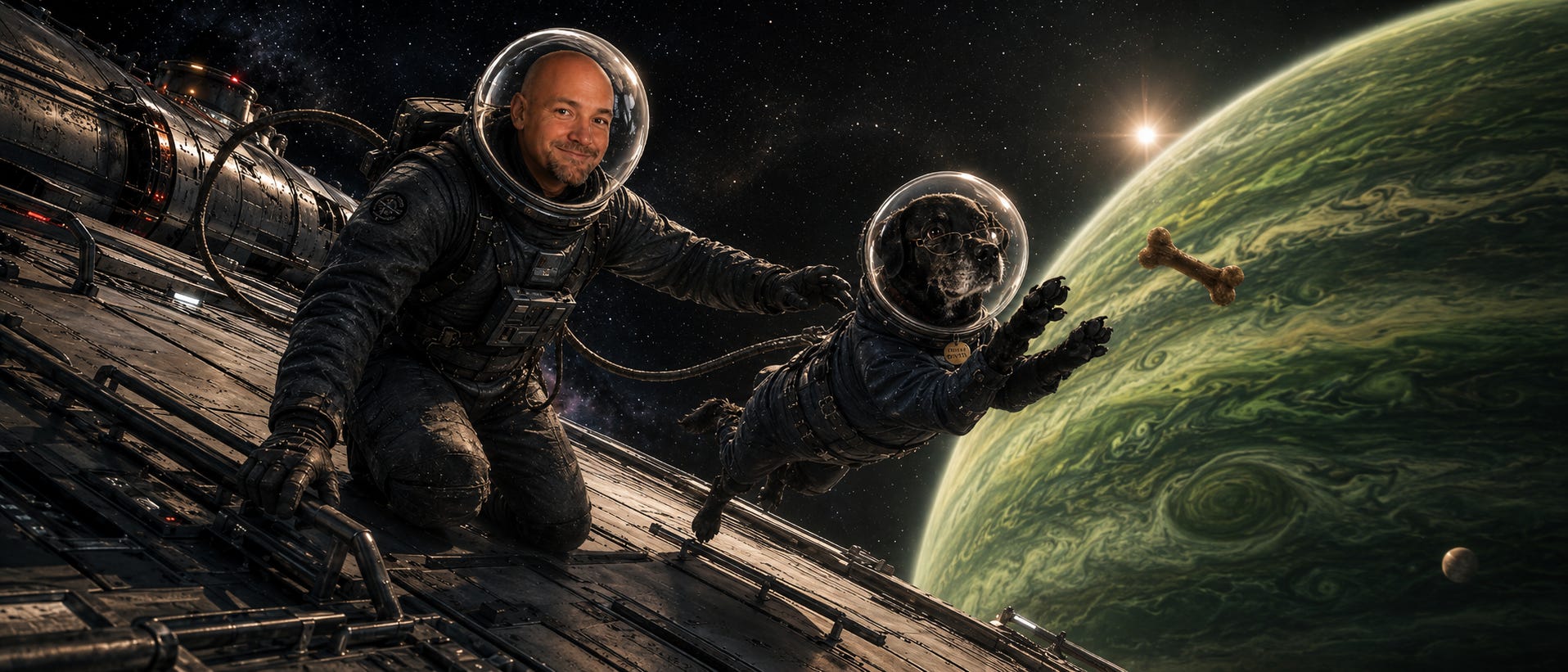
The willing suspension of disbelief isn’t the equivalent of a blank check. The problem with Project Hail Mary isn’t that it asks the audience to believe impossible things. That’s what movies do. That’s what science fiction and cinema itself have always done. I have no problem with invented science and emotional leaps. I’m down for an alien intelligence rendered through metaphor. I don’t go to movies demanding laboratory realism. I go because a film can persuade me, for two hours, that something impossible is emotionally real and cinematically true.
But persuasion is the missing piece here. The phrase is “willing suspension of disbelief,” but the audience is not the only party in that contract. The viewer brings willingness; the filmmaker has to bring their craft. You cannot simply put a sentimental creature on screen, surround it with problem-solving, and assume wonder is going to follow. Wonder has to be staged and arrived at. Innocence, by its nature, must be protected. Sweetness has to be earned. Otherwise, what should feel miraculous starts to feel mechanical, or worse, like a puppet being pushed toward the audience with a sign around its neck that says: please find me adorable.
Tonally and emotionally, this movie was the equivalent of an episode of The Muppet Show. Don’t get me wrong—I love The Muppet Show. But this movie promised real science fiction, not a kiddie flick. The register—the winking and the unrelenting insistence that every emotional beat is being set up for a payoff the film itself finds slightly amusing—is closer to variety television than to the cosmic seriousness the premise promises. A man alone in deep space, the last hope of a dying Earth, encountering the first non-human intelligence humanity has ever met. And the movie’s instinct, again and again, is to cut the tension with a gag, to soften the strangeness with “charm”, to reassure us that nothing here will actually disturb us. It is the most sustained rapid-fire of one-liners I have ever been subjected to. They never end.
The cute factor is laid on so thick in service of keeping us comfortable that there is never any strangeness, fear, tension, escalation, or danger. Zero cost is exacted in this film. People keep calling it hopeful. What exactly was this movie hoping for?
The space-crisis movie may have seen its day, because there is nothing new here. It’s become tiring watching an astronaut swap out sunglasses and a beach hat while sipping vodka on a spaceship.
One thing I would never expect to have to tell a professional storyteller: do not have your hero label themselves brave. Especially not preceding a flashback showing that same hero induced into a coma because he was too afraid to board the ship. Super weird choice! He was tossed onto a spaceship, sent light years into orbit, woke up decades later, never having trained for zero gravity or a spacewalk—and yet he is crawling along the exterior of the hull while skimming the fiery atmosphere of an alien planet. There is no universe where that logic arrives at this narrative.
Compare it to Gravity. Gravity wasn’t a great film. It was a little woo-woo, and I would not call it profound. But it was a competent one, and competence in this genre means honoring the silence and the danger that is contained in the cosmos. The terror was real. The physics felt like physics, even when it was not. The film never undercut its own dread to reassure the audience. It chose a register and stayed in it. If a workmanlike space movie can build genuine tension, the question of why a far more expensive, far more ambitious production cannot isn’t a question about the limits of the form. It is a question about choices.
And then there is E.T., which is the unavoidable comparison for the other half of what Project Hail Mary is trying to do. E.T. works not because the creature is realistic, but because Spielberg understands how belief is built: through behavior, rhythm, and point of view. Childhood fear, domestic texture, and emotional restraint were all tools he used. None of these conventions were present in PHM because that’s not what this story was about. E.T., the creature, is strange, but the world around him is so carefully observed that the strangeness becomes acceptable. The sweetness is not imposed; it is discovered. That is why E.T. never feels like a gimmick, even though in lesser hands he absolutely could have. The point being, in PHM, Rocky should have remained strange and somewhat remote. Cute shouldn’t have existed in this film. Cute is exactly what we got. A lot of CUTE! Rocky was as accessible and about as complex as an assembly-line stuffed toy.
Project Hail Mary, by contrast, feels like it mistakes cleverness for wonder. It’s full of ingenuity, or at least gestures toward ingenuity, but ingenuity isn’t the same thing as drama. Problem-solving isn’t the same thing as character. A puzzle box is not automatically a movie. The film seems to believe that if it keeps producing solutions, the audience will arrive at awe. But awe doesn’t come from watching mechanisms click into place. Awe comes from being made to feel that something vast, mysterious, and emotionally consequential has opened in front of you.
There is something stranger going on with this film that is harder for me to identify. I haven’t seen a movie where every individual component is so visibly accomplished and yet so visibly not contributing to anything coherent. The cinematography is beautiful. The production design is detailed. The cast is accomplished. The score is well made. And none of it adds up to a movie. It’s a shiny disco ball: it makes an entrance into the room. You can’t get out from under it or avoid it. There’s nothing inside it. The usual auteurist complaint is that the parts were great but the whole didn’t cohere. This is something worse. The parts are visibly competent, and you can still tell, watching it, that no real talent is operating at the level where decisions get made. The surface is doing all the work.
I should say: I went in wanting to love it. The trailer that came out months before release is, in my view, one of the finest pieces of film advertising I have ever seen—a complete narrative arc, perfectly cut, promising the kind of serious science fiction the genre doesn’t commit to anymore. If the movie had been the trailer, it would have been legendary. In my mind, the trailer still is—a great piece of art in and of itself. I wonder, sometimes, whether the trailer was so well crafted that audiences arrived at the theater having already seen, in their imaginations, the film they wanted, and whether they have not yet been able to disentangle that imagined film from the one that actually played. I include myself in this. I came in willing. The film did not meet me there.
To be very clear: this isn’t a complaint that every film must be austere, grave, or psychologically brutal. I love many kinds of movies. I can accept innocence. I can accept corniness. I can accept optimism. I can accept fake science if the movie helps me believe in it while I’m watching. What I can’t accept is the assumption that because a story is sweet, I’m required to be moved; or because it is clever, I’m required to be impressed.
For me, Project Hail Mary represents a larger problem in modern genre storytelling: the confusion of concept with execution. A big idea isn’t enough. A lovable alien isn’t enough. A series of clever reversals isn’t enough. The film has to create the conditions under which those things feel inevitable and emotionally true. Without that, all the machinery is lying all over the floor.
I wanted wonder. I got engineering. I wanted mystery. I got explanation. I wanted to believe. The film never convinced me that it knew how to make belief happen.