
Don’t Be So Dramatic!
Cinema Never Really Left Us. An Opinion Piece.

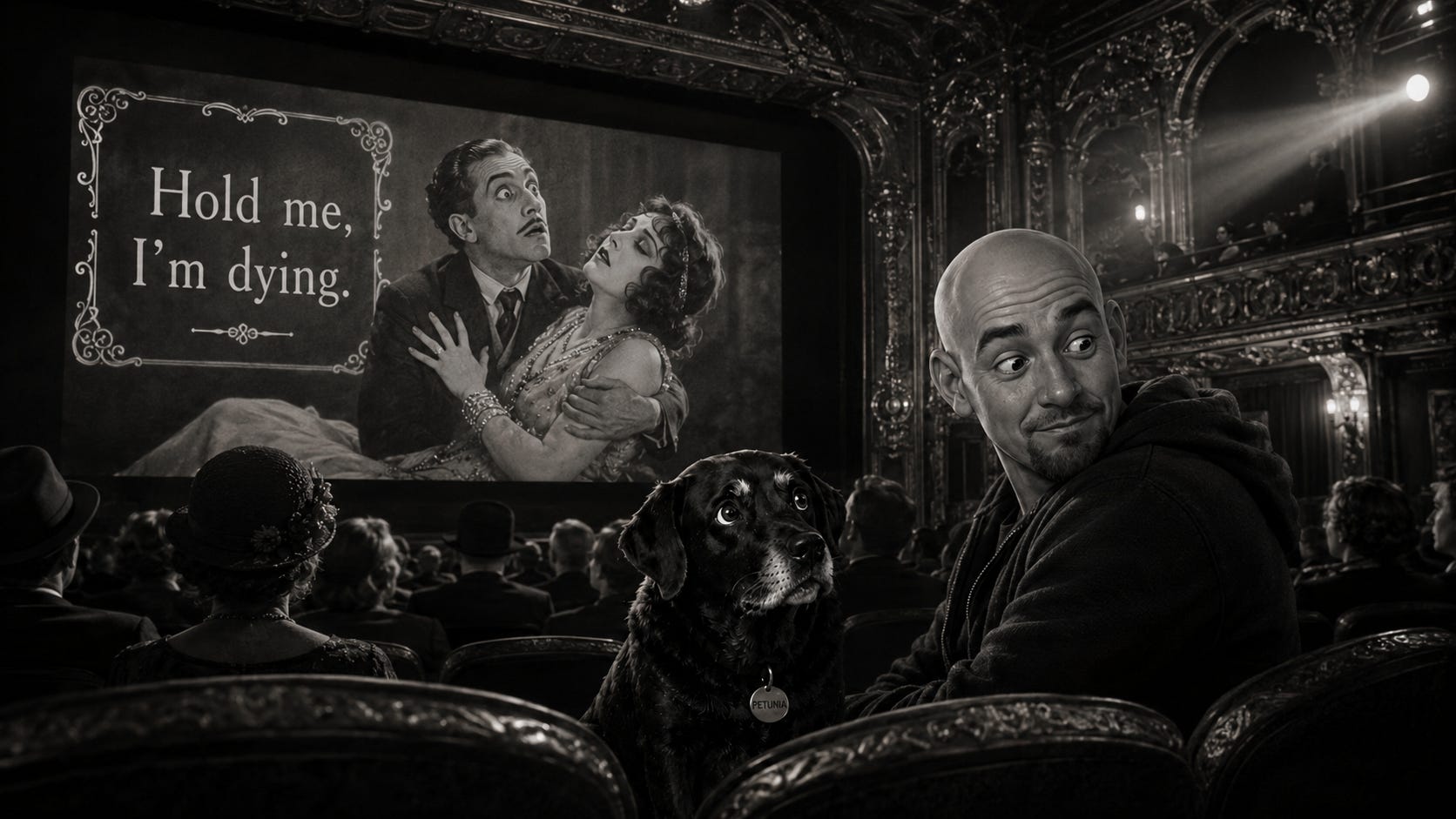
Every few weeks, someone discovers that cinema is dying. The discovery is almost always presented as a provocation, though by now it provokes nothing in me except a low grade wave of nausea. The headline arrives with its hand on its chin: Is cinema dying? Is the movie theater finished? Has streaming killed the art form? Is this the end of everything?
Of course cinema is not dying. Cinema is dying in exactly the same way theater was dying, and books were dying. Radio was dying, and music was dying. Then…television was dying. Which is to say, not dying at all, but changing position inside the culture. A medium can lose dominance without losing life. It can stop being the central public language of an era and still remain an irreplaceable form of human expression. Stories migrate. Attention migrates and then returns. But the need for form doesn’t vanish, and neither does the medium that can uniquely hold it.
The trouble with these essays is not that they are too worried about art. It is that they are not nearly worried enough about boredom. There is a kind of criticism that mistakes a question mark for an idea. It poses a stale question in the posture of deep concern, circles it for two thousand words, and then drifts away having never really answered it. The question was never an inquiry. It was stage-work. It was a little black turtleneck with a laptop.
A real version of the question could be worth asking. What happens to cinema when theatrical exhibition is no longer the default center of movie culture? What happens to film language when most people encounter it on laptops, phones, living room screens, or inside headsets? What happens to the economics of production when the cost of tools collapses and the routes of distribution multiply? Those are serious questions. But they are not the same question as, Is cinema dying? That question is usually just a fog machine.
Since the panic of the moment is cinema, let us spend one second with that particular corpse before someone orders flowers. Do we really think cinema is going to die? I do not ask that as a man emotionally attached to cinema, though obviously I am. I ask because the premise is on its ear. We are talking about a species so starved for companionship, attention, approval, likes, and an audience for every stray thought and minor action that we have built vast global systems to reassure ourselves that someone, somewhere, noticed us. And within that species, we are supposed to believe that a form allowing hundreds of people to sit together in the dark, reach toward the same dreams, scream at the same horrors, laugh at the same jokes, and ask the same old questions that have followed human beings through the entire comic misery of recorded history is simply going to vanish? Based on everything we know about human beings and their pathologies, this does not strike me as the likeliest outcome.
The reason is not just social. It is also imaginative. Human beings have always needed ways to work through realities that are too large, or unreachable to approach directly. We do it in dreams, turning fear and longing into images and metaphors before we even know what we are doing. We do it in stories, songs, rituals, plays, novels, and eventually movies. Cinema did not invent that need. It gave that need one of its most powerful rooms. A movie theater is, among other things, a place where private metaphors become public weather systems, where a crowd can sit together and let the same image pass through individual nervous systems at once. In that sense, cinema may have been part of us before cinema existed. Not as projectors and screens, but as a hunger: to gather, to dream collectively, to make the unreachable visible, and to test our private fears against the reactions of other bodies in the dark.
Very, very, let us add one more very, often, when a new technology or platform appears on the horizon, the first response from the existing order is panic. Whatever is coming is said to be a replacement for whatever has already been here. Film will kill theater. Television will kill film. Streaming will kill television. Digital cameras will kill photography. Artificial intelligence will kill art. The sentences change costumes, but the drama remains identical. This is where the low-grade nausea settles in.
The panic is rarely as pure as it pretends to be. The people most loudly defending the form are often defending something near to the form: their position near it, their authority over it, their wealth, their ability to decide who gets in and who remains outside. They say, This will destroy cinema, when what they often mean is, This may destroy my privileged relationship to cinema. It may destroy the cost barrier. It may destroy the means by which permission is granted.
That does not mean all concern is dishonest. It would be foolish to pretend that every new technology arrives bearing only gifts. Technologies shutter as well as open. They cheapen and also liberate. They create new habits, and new forms of laziness. They afford new opportunities for theft, mimicry, and slop. There are reasons to consider what gets lost when tools become easier, faster, and cheaper. But there is also something deeply suspicious about a person who claims to love art and then responds with dread when the tools of art move closer to ordinary human beings.
Anyone who truly loves art, and understands its power to make us greater than we have been, should feel at least some awe at the fact that a fifteen-year-old kid with an iPad can now attempt something that once required millions of dollars, years of access, and an army of people. That does not mean the attempt will be good. Most attempts at art are bad. They always have been. For the foreseeable future, for a million obvious reasons, they very probably always will be.
This point is the real pivot, because without it the argument becomes too easy to dismiss. I am not saying democratized art is automatically good art. It absolutely is not. Contained within that category is some of the worst art ever made, and perhaps some art so bad that previous civilizations were spared it only by the mercy of high production costs. But bad art is not an invention of access. Bad art isn’t something democratization unleashed upon a previously pristine landscape. There was always bad studio filmmaking, bad literary fiction, bad theater, bad painting, bad everything. The constrained world produced mountains of mediocrity and slop for as long as we’ve been creating anything at all. It just often had better lighting, better distribution, and more expensive self-regard.
No institution, platform, technology, container, or corner, has a monopoly on bad art. The good stuff is the rare stuff. It is rare in studios, rare in publishing, rare in galleries, and rare on stages, and, I am told by reliable witnesses, possibly somewhere on TikTok, though I have never seen it myself. Not once. Not as a purist or as a snob. Not as a man fainting onto a divan because the young people frightened him. I mean quite literally that I have never encountered anything there that felt worthy of the time it took from me. I don’t know why. Incentive structure?? That’s another piece for another day, I think.
Still, the larger point holds. Democratization does not improve the ratio of good to bad. It changes who is allowed to try, and where the rare good thing might come from. Give everyone a camera and you’ll get bad photographs. Give everyone a pen and you will get bad poems. Give everyone a guitar and, God help you, eventually one of them will sit too close to you and begin.
This is not elitism. This is trauma. Anyone who has ever been trapped at a party by a man settling onto a stool with an acoustic guitar knows that democratized access can become a hostage situation almost immediately. The amateur guitarist does not perform for you so much as happen at you, like a mime on public transportation. The issue is not that everyone has a guitar. The issue is that everyone with a guitar eventually discovers eye contact.
And yet, even there, access is not the villain. The existence of unbearable guitar players does not mean guitars should be kept in vaults and distributed only by conservatories. It means that most attempts will be embarrassing, self-involved, and sometimes acoustically coercive. That has always been the case. What matters is that the rare good thing no longer has to pass through the same narrow institutional machinery before it can exist.
The other mistake in these death-of-cinema arguments is that they treat technological succession as replacement, when the history is much stranger than that. What usually happens is not death but rearrangement. A form loses its position as the dominant commodity and then, almost magically, becomes more valuable as an experience. The thing that was once ordinary becomes curated. The thing that was once merely how you consumed the work becomes an occasion, a ritual, even a premium encounter.
Vinyl was supposed to die. Now, it’s a badge of honor. Live performance was supposed to be weakened by recording, then by radio, then by television, then by streaming. Movie theaters were supposed to vanish into living rooms. Books were supposed to disappear into screens. Yet the older forms keep returning, often charged with new meaning. They become more tactile, and more ceremonial. Yesterday’s default can becomes today’s fetish object. Yesterday’s commodity becomes today’s pilgrimage.
There is a comic rhythm to this. The new form arrives as the vulgar intruder, the death machine. Then, given enough time, that same form becomes the fragile old thing everyone wants to protect from the next vulgar intruder. Yesterday’s assassin becomes today’s temple. CDs were going to murder vinyl; then CDs became the wounded artifact. Streaming was going to flatten music; now streaming itself is simply the ordinary air through which music travels, waiting to be challenged by whatever comes next.
Every generation sanctifies the format that shaped its own attention. Someone born into vinyl hears warmth and presence. Someone formed by CDs remembers the object, the booklet, and the possession. Someone formed by streaming may attach meaning to the private, frictionless intimacy of listening in the dark, alone in bed, with the whole history of recorded music glowing invisibly from a rectangle on the nightstand. None of these experiences cancels the others. They layer. They argue. They change value as the world moves around them.
This is why the replacement story is so inadequate. I can lie in bed at night listening to an album on a streaming service and have an experience that feels almost sacred in its intimacy. In that moment the words of that song can land on me like they never have previously. Then I can plan a road trip, spend too much money, meet friends, and see that same music performed live. The private streaming experience has not diminished the public one. It has prepared me for it. It has thickened the encounter. The bedroom and the concert hall are not enemies. They are two different rooms in the same relationship.
Cinema works this way too. Watching a film at home does not automatically murder the theater. It can cheapen certain kinds of attention, yes. It can make us casual, interrupted, inattentive, even lazy. But it can also deepen attachment, allow revisiting, encourage study, create relationships with films that later become public, theatrical, communal, even devotional. I’ve done some hard, successful viewing from my bed or my sofa with the dog’s head on my leg. A person can discover a movie on a television, revisit it on a tablet, teach it in a classroom, write about it on a laptop, and then see it projected in a theater with a new hunger. This has been a delightful cycle I have ridden many times. The forms feed one another more often than the death announcements admit.
So the question is not whether cinema is dying. The question is whether we are capable of describing change without immediately reaching for an obituary. A medium will change technologies, venues, economics, and hierarchies. That is not the same as death. It is culture breathing through different instruments.
The real anxiety is often not that art will disappear, but that art will escape the people who were used to standing at the entrance. That is a different matter. It deserves to be identified directly. If a new tool allows more people to try, most of what they make will be bad. Fine. Most of what everyone makes is bad. But somewhere inside the mess, the vanity, the slop, the bad essays, the bad songs, the TikTok whatever-it-is, and the man with the guitar making smothering eye contact, something rare may appear that would not have appeared otherwise.
That possibility should thrill anyone who loves art more than status. It does not require us to lower our standards. It requires us to remember what standards are for. They are not there to protect the old machinery of permission. They are there to help us recognize the rare thing when it arrives, wherever it arrives from.
Here comes the list… because the list is the thing! Cinema is not dying. Neither is theater, literature, music, radio, television, photography, or the album. They are all shifting, mutating, trading places, losing monopolies, becoming ordinary, becoming precious, becoming sacred again. Every medium is dying until it remains alive. Every funeral eventually presents as a period piece. And every few weeks, someone writes another one, lights the candle, lowers the voice, and announces the end of cinema. Somehow, cinema survives the diagnosis.