
Supergirl (2026)
Beware of Very Slow Moving Bullets. A lot of Them!

I am surprised by how much there is to say about Supergirl, because the movie itself is not especially complicated. It is not profound. It is not sophisticated. It is not even particularly dense. It is thin on plot, stretched in places, visually overstuffed, and too often governed by someone else’s sensibility. And yet it is also not a disaster. It is not the catastrophe some people seem to need it to be. It is more solid than many superhero films, and in a few places, it works in a clean, direct, almost old-fashioned way.
That is what makes the reaction to it so strange. Reviewing the film without reviewing the public conversation around the film would feel dishonest, because the conversation has become part of the experience. Not because it illuminates the movie, necessarily. In some ways, it does the opposite. The conversation threatens to replace the movie with something louder, uglier, and much less specific.
Supergirl is not good enough to deserve martyrdom and not bad enough to deserve an execution. It is a modest, uneven superhero movie with some genuine virtues and some very familiar franchise problems. But out in the ether, the response has been behaving as if this movie were a major cultural provocation, as if the film itself has committed some symbolic offense that must be prosecuted. That mismatch is where the real strangeness begins.
There is a complaint about modern franchise storytelling that I don’t entirely dismiss, even though I often dislike the people making it and almost always dislike where they take it. We have all seen the version of the “strong female character” who is not strong because the writing has imagined a human being with courage, contradiction, and will, but because the movie has placed a halo over her head before the story begins. Everyone around her is diminished so that she can appear enlarged. The men are stupid, corrupt, useless, or cruel, and the woman is virtuous by default, as if virtue were a demographic category rather than a dramatic achievement.
That kind of writing does exist, and it is irritating. It is also very different from Princess Leia in Star Wars or Lois Lane in Superman: The Movie, women whose force does not depend on the humiliation of everyone else in the frame. Leia is magnificent because she belongs to the world around her and knows how to move through it. Lois is great because she is fast, funny, vain, brave, and reckless. Their strength is interactive. It has friction. It is not a certificate issued by the screenplay.
But Supergirl does not strike me as that sort of character. The movie has problems, and I am not interested in pretending otherwise. But I also did not feel that I was watching a man-hating production disguised as a superhero movie. I felt that I was watching a story about a damaged hero confronting a real form of evil. The fact that this hero is female is relevant and specific, but it does not flatten the story into a slogan. She is not good because she is a girl. She is a girl who is trying, painfully and imperfectly, to become good.
That distinction is the entirety of it. A woman fighting sexual predators is not, by definition, an attack on men. Sexual predation exists. Human trafficking exists. So does coercive violence. These aren’t inventions of studio ideology; they are among the ugliest facts of the world. Superhero movies have asked us to accept glowing cubes, sky portals, multiverses, alien gods, and raccoons with machine guns. I do not see why the genre suddenly becomes intolerably artificial when it turns one of reality’s actual evils into a villain.
I want to be careful here, because this is a hot stove I have touched before from the other side. I have disagreed with women online and been told that my disagreement could only mean one thing: that I was just another man who hated a woman with an opinion. That is not true, and I know how dishonest and flattening that accusation can feel when it is used to end an argument rather than answer one.
So I do not want to make the same mistake in reverse. I am not saying that every critic of Supergirl is a misogynist. I am also not saying that every objection to Milly Alcock is invalid. I am not saying that a woman’s opinion becomes immune from criticism because it comes from a woman. Women can be wrong, glib, evasive, arrogant, shallow, or simply mistaken in exactly the same ways men can.
But that is not quite what I saw happening. By this morning, a sentence had started appearing often enough on Substack that it no longer felt like an opinion. It felt like a chant. The more Milly Alcock opens her mouth, the lower the opening weekend will be. I saw some version of that line again and again, close enough in phrasing that the repetition became more disturbing than the sentiment itself.
The objection was not simply to something she said. The objection was to the fact that she kept speaking. This is different. Not “I disagree with her.” Not “That was a bad answer.” The complaint became the opening of her mouth itself. The act of speaking. The presence of a young woman in public, talking, having a personality, and not performing the expected version of gratitude or silence.
Because I know how cheap the accusation can be when it is made carelessly, I want to be precise when I say this: the pattern around Alcock did not feel like ordinary disagreement. It felt like correction. It felt like a warning. Stop talking. Every time you speak, you hurt the thing you are supposed to be selling. Whether everyone repeating the line understood its implications or not, the line carried them.
That is not film criticism. That is discipline or punishment.
And the movie itself does not justify that kind of hysteria. If anything, the film is too inert for such an enormous public trial. It is thin on plot, which is not automatically a problem. A movie can have almost no plot and still be great. Plot is not the same thing as movement, and movement is not the same thing as meaning. Some of the greatest films ever made are built on the slimmest narrative scaffolding imaginable.
The problem with Supergirl is not that its plot is thin. The problem is that the movie behaves as if it has adopted a more traditional narrative shape than it can actually fill. It has the outline of a revenge quest, the machinery of pursuit and confrontation and reluctant moral awakening. But the story feels stretched over that structure rather than generated by it. There is enough here for a sharp, strange, bruised little movie. There may not be enough here for the shape it has been forced to occupy.
What struck me more than the thinness of the plot, though, was how little the film felt like Craig Gillespie. It is not that I am some enormous partisan of Gillespie’s work, but he is a real filmmaker. I, Tonya and Cruella are not anonymous movies. They have attack, velocity, and an interest in women whose personalities are too jagged to be made palatable. Whether one likes those films or not, they do not feel assembled by committee in quite the usual way.
Supergirl does. Or rather, it feels assembled by a very specific committee of one. Down to the costumes, the makeup, the cosmic clutter, the jokes undercutting peril, the tavern-like corners of the universe where freaks and wounded heroes cross paths, this does not merely have a James Gunn flavor. It feels James Gunn all the way down.
That is not entirely an insult. Gunn has a genuine comic-book imagination, and there are worse house styles to imitate. But the degree of resemblance is strange. At times Supergirl feels less like a Craig Gillespie film set inside the new DC universe than a James Gunn film directed by Craig Gillespie. And that raises a question the movie never really answers: why hire a director with an identifiable sensibility if the final product is going to feel so thoroughly governed by someone else’s?
A movie can be unfairly attacked for stupid reasons and still fail for real ones.
In this film, the hardest idea to swallow belongs to the production design. The destruction of Krypton has been reduced from myth to contraption.

The problem is not simply that the idea is scientifically silly. Comic book movies are full of scientifically silly ideas, and many of them work beautifully. The problem is that this one is silly in a way that punctures the myth. Superman: The Movie gives us Krypton as tragedy: a civilization ending, a child sent into the stars, and a father’s love surviving the death of a world. Great! Fine! Beautiful! Now we find that Krypton’s capital city has outlived the planet’s destruction for decades. This is a serious head-scratcher. The source material is irrelevant. Regardless of where this idea first appeared, it has the bitter taste of a bolted-on afterthought if anything ever has. Supergirl turns that clean myth into a zoning problem with a force field. Apparently, one scientist, Jor-El’s brother, has secretly built a tower, in the middle of the city, capable of throwing a protective dome over the geography and its inhabitants, so that when Krypton explodes, a chunk of the planet survives as a piece of rock floating through space with a golden bubble on top of it. Krypton becomes a cosmic snow globe.
And once the movie has made that choice, it has moved us from myth into infrastructure. How does this city have running water? Weather? Rain? Livestock? Crops? Waste systems? A sustaining atmosphere? A social order that does not collapse almost immediately? This list could be longer and more unforgiving. The movie explains enough to make the image literal, but not enough to make it believable. This is the worst of both worlds. It over-explains the mystery and under-imagines the consequences. What should feel tragic instead looks like something a bright nine-year-old might draw and then proudly label “Force Field City.” I do not mean that as an insult to nine-year-olds. At nine, I probably would have loved the idea. But a blockbuster cannot live on the emotional architecture of a doodle.
The film also seems to be offended by the idea of allowing the viewers eye to rest. Anywhere! Ever! It is not wrong for a cosmic superhero movie to be cluttered. Space should not always look like a clean polished surface. There is a long and honorable tradition of junked-up science fiction: ships with grime in the seams, outposts built out of salvage, taverns full of strange objects and stranger faces. A universe can feel more lived-in when it looks as if people have been breaking, repairing, trading, and abandoning pieces of it for centuries.
But Supergirl often pushes that idea past texture and into interference. So much of the frame seems scattered with matter: scraps, pipes, makeup effects, little objects, little lights, little jokes of design... It does not merely feel detailed. It feels strewn. After a while, the eye starts looking for a clean place to land and cannot find one.
That was when the movie most reminded me of Guardians of the Galaxy, especially the outer-space outpost imagery of Knowhere: the same dirty cosmic marketplaces, the same sense that every surface has been deliberately distressed, dented, scuffed, or occupied by some odd little thing. Sometimes that works. Sometimes it is lovely. Sometimes the density gives the movie a pleasingly handmade weirdness.
But sometimes it becomes smothering. The movie feels dirty in a way that goes beyond atmosphere. You almost want to wipe the frame clean so you can see what is happening. It is like trying to watch through a windshield wiper in a mudstorm. The design is so insistent on its own clutter that the clutter starts to feel artificial — not the mess of a real place, but the curated mess of a production department trying very hard to make a place look real.
That is the difference. A lived-in world has evidence of life. An overdesigned world has evidence of design. Supergirl often lands somewhere between the two, and when it fails, it fails because the objects do not deepen the world. They crowd it.
This is where my affection for James Gunn’s sensibility runs into my fatigue with it. I like Gunn. I like his affection for cosmic losers, dirty corners of the universe, vulgar jokes with little hearts inside them. At his best, he understands that the discarded thing may be the thing with the soul in it.
But I do not want to overstate this, and I certainly do not want to pretend I know anything about James Gunn personally. I do not. That is part of the problem, actually. Watching these movies, I sometimes feel as if I am being asked to know him a little too well.
That is not a psychological complaint. It is an aesthetic one. I do not want to plunder the psychology of James Gunn. I want to watch the movie in front of me. But the movie keeps pointing back toward the personality organizing it: the same cosmic clutter, the same broken toys, the same baroque scuzziness, the same sense that freaks and rejects are the only people worth trusting.
Again, I like that sensibility. I really do. At its best, it has produced some of the most emotionally persuasive superhero filmmaking of the last fifteen years. But a sensibility can become too available. It can become so recognizable that it stops opening the movie outward and starts pulling everything back toward itself.
That is what worries me here. Supergirl often feels less like a film discovered by Craig Gillespie than a film filtered through the already-established grammar of James Gunn. The result is not lifeless. It has color, jokes, movement, a marvelous dog, and a heroine I would happily follow into a better movie. But it also feels over-authored from a distance. Not directed by Gunn, exactly, but governed by Gunn. And governance is not the same thing as imagination.
If this universe is going to work, Gunn may need to trust the people he hires to make movies that do not constantly remind us of him. Let the sensibility loosen. Let another filmmaker’s eye interrupt the house style. Otherwise the very thing that once made his work feel eccentric and resistant could harden into brand management.
The larger problem, and the one that may eventually doom this entire enterprise, is the machinery of the DC Universe itself. I know this is the plan. I know this is the job. James Gunn and Peter Safran were hired to build a connected universe, and connected universes connect. That is not a scandal. It is the business model.
But it is also the tax every one of these movies now has to pay.
At this point, I feel like I am screaming into the void: please stop doing this. Just make good movies about these characters. Let Superman be a Superman movie. Let Supergirl be a Supergirl movie. Let Peacemaker be Peacemaker. Every time one of these stories turns its head toward some larger thing being built in the distance, the movie in front of us gets smaller. The attention shifts from experience to architecture, from drama to placement, from what is happening now to what this might mean later.
That is not world-building. Or at least it is not only world-building. It is franchise debt.
The strangest part is that DC seems to want what Marvel had, without really thinking about what Marvel has turned into. For a while, (a short while), that whole interconnected thing felt like magic. Characters crossing over, stories linking up, everything building toward something bigger — it worked. But eventually it stopped feeling like magic and started feeling like homework. You had to keep track of everything. The timelines got messy. The movies stopped feeling like events and started feeling like obligations.
And that’s what DC seems to be chasing, which just makes me want to ask: why? Why go after that exact model right when it’s clearly running out of steam?
There’s a much better option sitting right there. Just make great superhero movies. Not a giant universe first. Not a continuity puzzle. Just focus on getting each character right. Let Superman have a great Superman movie. Let Batman have a great Batman movie. Let Wonder Woman have a great Wonder Woman movie. Same with Supergirl. None of them needs to be constantly setting up the next thing or tying into some bigger plan.
That would actually stand out. Marvel already built the maze. DC doesn’t need to copy it. They could just be the studio that remembers how to make a really good movie.
Wonder Woman belongs in this discussion too, at least briefly, because DC has already had this opportunity once. The first Wonder Woman was not just a hit. It was a deeply enjoyable film with both feet planted firmly on the ground. It had myth, romance, comedy, violence, and sincerity, but it also had a clear dramatic shape. Gal Gadot was perfectly cast, and the film understood something very basic and very powerful: Diana’s goodness was not decoration. It was intelligence. It was strength. It was the same kind of moral clarity that made David Corenswet’s Superman work.
That trench sequence in World War I remains one of the great modern superhero moments. Diana steps into view, and the movie suddenly remembers what these characters are for. Not branding. Not homework. Not future setup. A person with extraordinary power sees suffering and moves toward it. That is the stuff superheroes are made of.
Which is why the failure of Wonder Woman 1984 matters here too. The problem was not Wonder Woman. It was not Gal Gadot. It was not Kristen Wiig or Chris Pine. The problem was a script that became self-reverential and strangely airless, as if the movie wanted to preserve the sensation of the first film by keeping familiar emotional pieces in motion instead of discovering a new reason to exist. It changed the year, but it did not find a new center.
That is the warning. DC does not need to be afraid of female heroes. It needs to be afraid of bad scripts, overbuilt universes, and movies that forget to be movies. Wonder Woman proved the opportunity was real. Wonder Woman 1984 proved how quickly that opportunity can be fumbled. Supergirl sits somewhere between those two lessons: not a disaster, not a triumph, but another reminder that these characters do not need a maze built around them. They need stories worthy of them.
This is also why the use of Superman in Supergirl bothered me. One of the things I genuinely loved about James Gunn’s Superman was David Corenswet. I do not think that casting accomplishment should be minimized. Every actor who followed Christopher Reeve was trapped by him in one way or another. They either had to imitate him, avoid him, or reinvent Superman into something Superman is not. Corenswet did something much harder. He let Superman be Superman again.
That does not replace Reeve in the cheap sense. Superman: The Movie remains a miracle — not a great superhero movie, but a great film. But Corenswet did, for me, become the living center of the new version. He understood that Superman’s goodness is not stupidity. It is not blankness. It is not the absence of complexity. It is a form of strength so alien to the modern imagination that people often mistake it for simplicity. Gunn’s Superman was not a great film, but its Superman was a great Superman, and that is the thing that mattered most.
Which is why his use in Supergirl bothered me. There was no real need for him to be here, at least not in the way the movie uses him. He functions less like a character than connective tissue, a reminder that this film belongs to a larger structure. Worse, the movie pushes his goodness toward the edge of foolishness. The intelligence inside his innocence starts to drain away, and he begins to look less morally clear than merely gullible.
That is not a small problem. You do not get to do that too many times before you damage the thing you just created. If Superman’s goodness is strength, then the films have to protect that strength. They can test it, misunderstand it, even let other characters underestimate it. But the movies themselves cannot treat it as stupidity. Once Superman becomes the butt of the joke, the whole moral architecture starts to wobble.
This was already a danger in Gunn’s Superman with Ma and Pa Kent, whose sweetness sometimes slid too far into doe-eyed comic simplicity. Supergirl teeters near the same edge with Clark. The movie seems to enjoy his decency, but it also seems tempted to use that decency as a punchline. That is a dangerous temptation. Superman can be gentle. He can be awkward. But he cannot be a fool, because if he is a fool, then the story is no longer asking us to believe in goodness. It is asking us to patronize it.
The great promise of Corenswet’s Superman is that his goodness has perception inside it. He is not good because he does not understand the world. He is good because he sees the world and chooses not to become cruel. Supergirl does not destroy that idea, but it does nick it. And in a franchise already too eager to turn every movie into a hallway leading to another hallway, that kind of damage does accumulate. They are not just connecting films. They are borrowing against the moral capital of the best thing they have.
One of the things that did work for me, in a surprisingly simple way, was the relationship between Kara and Ruthye. I want to phrase this carefully, because the point is not that there is something inherently superior about a girl being protected by a girl, or that a man protecting a woman is automatically false. That would be ridiculous. Movies have given us countless versions of physical rescue, emotional rescue, romantic rescue, paternal rescue, maternal rescue, and every one of those forms can work when the story earns it.
But there was something quietly refreshing about seeing a girl protected by another girl without the movie turning that protection into a sermon. So often, especially in genre films, the rescue pattern falls into one of two familiar shapes: a man saves a woman physically, or a woman saves a man emotionally. Those are not evil patterns, but they are exhausted ones. We have seen them so many times that the shape of the scene often arrives before the characters do.
Here, the dynamic felt cleaner than that. Ruthye needs help. Kara is capable of helping her. The relationship does not have to be sexualized, romanticized, paternalized, or turned into a symbolic referendum on all men and all women. It is simply one damaged young person trying to protect another, and for much of the film, that felt natural to me. Not profound, maybe, but true enough. Sometimes a strong personality enters the life of someone more vulnerable and becomes the shield for a while. That does not have to be about gender conquest. It can just be about care.
A superhero movie has to be judged, at least in part, by its villains, and this is one place where Supergirl seems to misplace its own interest. The film gives its plot to Krem, but its energy belongs to Lobo.
I have not always known what to make of Jason Momoa. He was very effective in Game of Thrones, but that role also used him as an object, and he was perfect as an object: huge, beautiful, dangerous, physically declarative. For a long time after that, I did not take him as seriously as perhaps I should have. Then Dune complicated that for me. His performance there had a generosity I was not expecting. At first I wondered if he only seemed better because the material around him was better, because Denis Villeneuve’s world gave everyone weight and scale. But the more I thought about it, the more it seemed that Momoa had brought something of his own into the margins: warmth, loyalty, appetite, humor, and a kind of unforced nobility.
Supergirl confirmed that I had probably been underrating him.
The material here is not nearly as strong as Dune, but Momoa is still one of the better things in the movie. His Lobo is not just a big galactic brute with a motorcycle attitude. He brings with him an entire social weather system: swagger, worship, danger, and the exhausted privilege of someone who has spent his life surrounded by people telling him he is magnificent. That is a recognizable kind of man. Enormous, celebrated, overpraised, underexamined. A man whose thoughts have rarely been asked to become thoughts because the room usually begins applauding before he has to finish one.
That could have been cartoonish, and of course Lobo is cartoonish by design. But Momoa gives him a second layer. He plays the vanity and the force, but also a flicker of bemusement underneath it, as if Lobo himself is a little tired of the worship he receives and not quite prepared for the strange pleasure of being challenged by this girl. Not defeated, exactly. Not morally converted. Nothing so tidy. Just interrupted. For a moment, the god of his own little cult has to notice that someone smaller, angrier, and clearer has entered the room and is not impressed.
That is valuable conflict. It is certainly more valuable than the movie seems to understand. Krem may be necessary to the plot, but Lobo is necessary to the movie’s texture. He gives Supergirl a contrast that feels alive: not merely evil opposed to good, but bloat opposed to purpose and to someone who has no interest in flattering it.
The movie does not need Lobo to become the central villain in the obvious sense. But it might have been stronger if it had recognized him as the more revealing one. He offers Kara something more interesting to push against than simple cruelty. He represents a whole ecosystem of indulgence and masculine self-regard, and the film seems to understand that for a few minutes at a time before wandering back toward a less interesting center.
And then there is the dog. The goddamn dog.
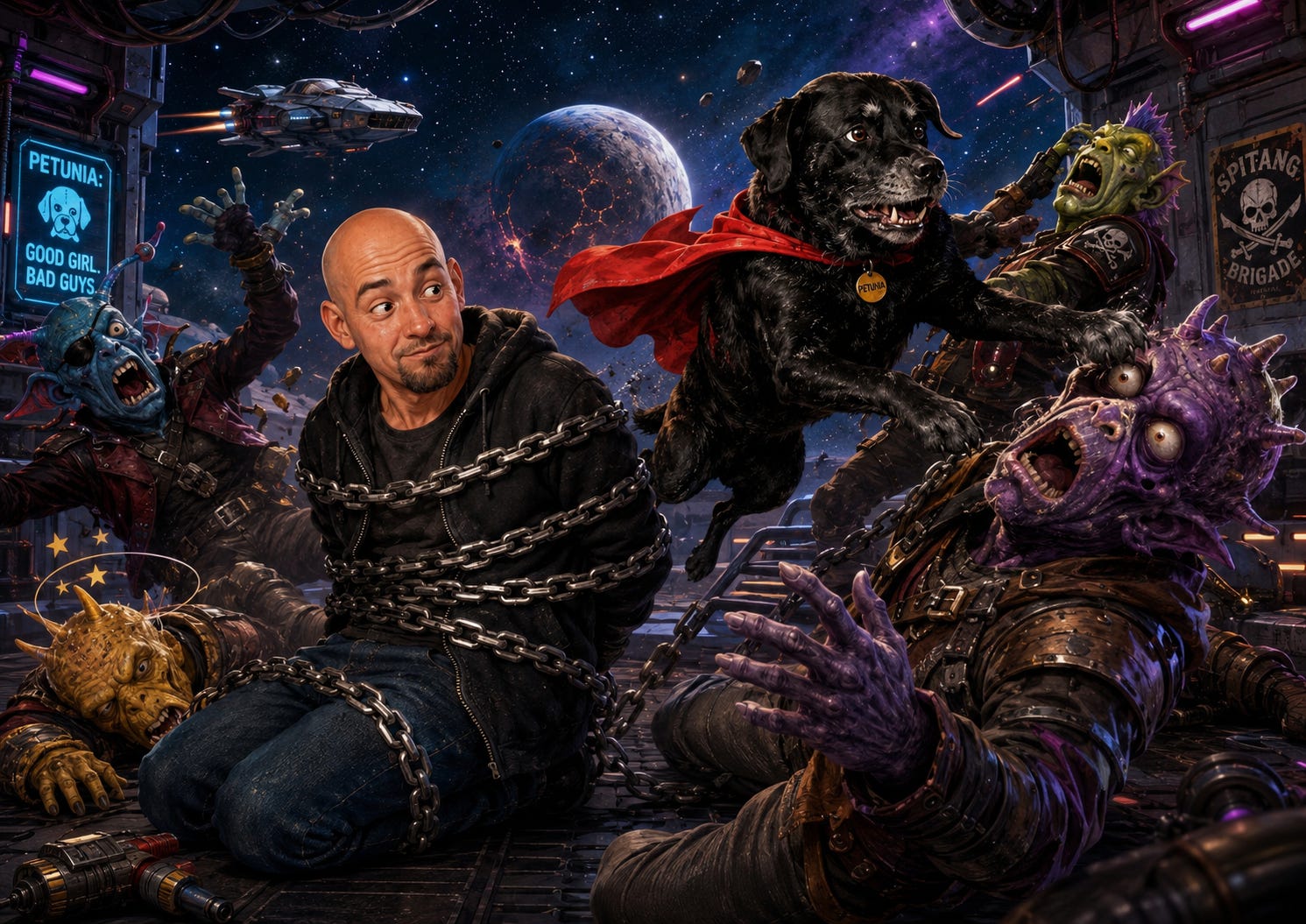
Krypto is the thing I cannot argue away. In a movie full of clutter, franchise machinery, thin plotting, and borrowed James Gunn textures, the dog works. Completely. Not as a cute accessory, not as a bit of comic relief, not as a merchandising opportunity, though I am sure he is all of those things too. He works as a living presence inside the film.
That is not a small achievement. A creature this central has to cross the hardest threshold in fantasy filmmaking: it has to become real enough that you stop measuring the trick. Yoda and Jabba the Hutt did that through practical magic. They were puppets, yes, but they had mass, texture, gravity, slowness, resistance. They occupied space. They made belief feel physical.
Krypto does the opposite miracle. He is not practical. He is computer-generated, and yet I never felt the computer. I remembered that after the fact. I did not experience it while I was watching him. He had weight. He had impulse. He had the irrational forward motion of an actual dog. He did not feel like an effect being placed into the frame. He felt like a body moving through the world of the movie with the same right to be there as any human actor.
There have been good digital characters before. Watto was a real accomplishment as far back as The Phantom Menace, even if not every digital creature around him was equally persuasive. But Krypto feels like some kind of pinnacle. I do not know how much more convinced I could be. Physically, emotionally, comically, he works. He has impact when he hits something, personality when he disobeys, sweetness without becoming syrupy, and enough animal chaos to keep him from feeling over-programmed.
More than anything else in Supergirl, he endeared me to the film. I liked Milly Alcock too. I liked her Supergirl. I would gladly watch her again, and I would happily cheer for her in a better movie than this one. But Krypto is the creature who made the movie matter to me in the cleanest way. He is where all the machinery becomes feeling.
So would I recommend the film? Yes, I think I would. Not wildly. Not evangelically. Not with a trumpet blast. But yes: go see it. I did not hate it. In places, I enjoyed it. Maybe I enjoyed it the way I might enjoy a Quarter Pounder with Cheese: with some guilt attached, and the suspicion that I could have spent my time better elsewhere. But I am not less for having seen it. I may even be a little more.