
Ted Lasso (2026)
A Soft Place to Land.

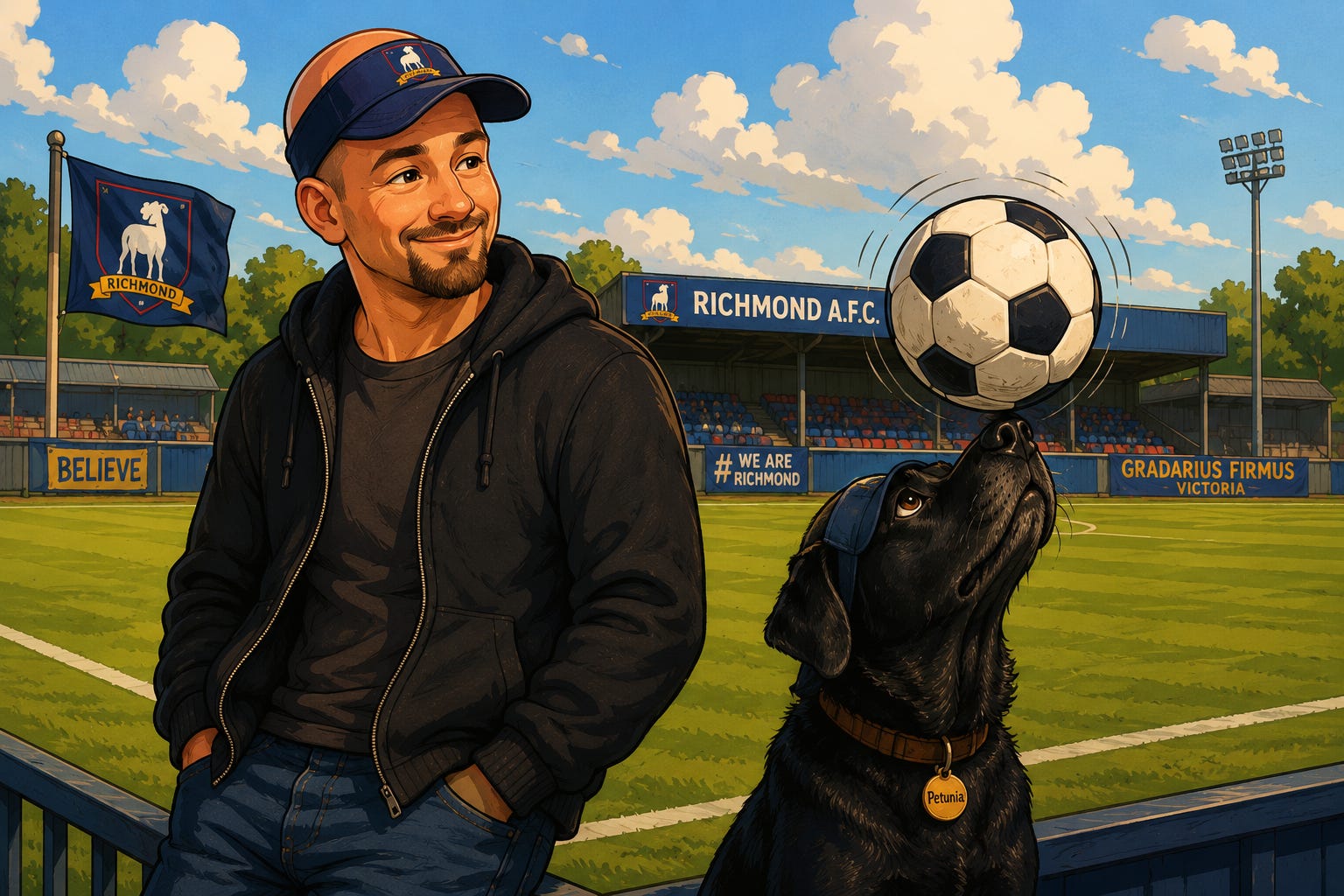
I didn’t know Ted Lasso was coming back last night.
I was aware, in a general sense, that the show had been revived. I had anticipated the eventual return of another season. However, somehow, the date had slipped my mind, and there it was, waiting for me as if it had never been absent. I pressed play without the usual anticipatory excitement that accompanies the return of a beloved show. There was no countdown or carefully constructed expectations built up over months. It was simply Ted Lasso, once again.
Almost immediately, I experienced an unexpected feeling: relief.
That may seem like an unusual word to describe a television show. It is also likely the most accurate one I have.
Ted Lasso has always puzzled me because I adore it so much. Bill Lawrence, one of its creators, is known for his comic sensibility in other shows like Scrubs and Shrinking. While Scrubs was never my cup of tea, Shrinking, which I enjoyed for a while, often veered dangerously close to that writers’-room condition where everyone is clever in the same way. The banter becomes monotonous, and characters lose their individuality, becoming mere vessels for a single comedic voice.
Ted Lasso, on the other hand, has a plethora of quips, possibly more than any other show. Ted himself can effortlessly bombard the audience with references, making language seem inadequate to keep up with his rapid-fire delivery. However, in Ted Lasso, the quirkiness lies in the characters themselves rather than the production. Roy Kent’s voice is distinct from Rebecca Welton’s, and Rebecca’s voice is different from Jamie Tartt’s. Jamie can craft sentences of such blissful, unselfconscious absurdity that no one else could possibly have uttered them. Ted’s relentless folksiness is uniquely his, and the show has even explored its origins over time. The jokes in Ted Lasso are not just decorative elements; they serve as camouflage, adding depth and meaning to the narrative.
Perhaps that’s part of the difference. However, I’m not sure it fully explains my feelings about the show because I don’t really consider Ted Lasso a comedy.
It’s undeniably funny, and sometimes it’s incredibly funny. But comedy feels more like a description of the delivery system than the actual content being delivered.
What Ted Lasso offers me is forty-five minutes of forgiveness and redemption every week.
That may sound embarrassingly earnest until you remember that Ted Lasso has never been embarrassed by earnestness. It has never felt the need to mock its own heart before someone else does. It doesn’t pretend that kindness is effortless, that decent people never make mistakes, or that forgiveness erases consequences. Its characters constantly hurt each other, disappoint one another, become jealous, or petty, and betray those they trust. The show keeps asking what happens after all that.
Can someone be more than the worst thing they have done?
Can room be extended before somebody has earned it?
Can decency serve as a private virtue, or can it also be a practical way of navigating the world?
These profound questions are woven into the very fabric of Ted Lasso, rendering its sweetness less superficial and more substantial. The show rigorously tests this proposition each week.
Somehow, the jokes manage to prevent it from becoming a preachy lecture.
I believe this is why my experience of watching Ted Lasso is so distinct from that of watching most other shows. There are films I adore immensely, films that leave a lasting impression. Normally, they compel me to dissect every decision and examine the underlying mechanisms. At the same time, there are films I detest that are almost as enlightening because they challenge me to comprehend why they failed to resonate.
Ted Lasso does not make me want to do any of that.
I do not really want to evaluate it.
I want to spend time inside it.
It is like laying down a room full of pillows and knowing that wherever you fall, something soft is going to catch you.
That’s not to say the show is inconsequential. In fact, I believe the opposite is true. There’s something almost therapeutic about spending time in a world where forgiveness remains a viable option. Sometimes, I walk away from an episode feeling like I’ve become a slightly better person than I was forty-five minutes earlier. Or, more accurately, I’ve been reminded of the person I aspire to be.
Perhaps that’s what the show excels at. It doesn’t teach virtue; instead, it allows us to practice it.
For a while, we live among people who keep trying again. We witness someone choosing patience when anger would be easier. We see someone discovering that humiliation doesn’t have to be met with humiliation. We observe people extending grace before they can be certain it will be reciprocated. And repetition matters. Spend enough time around a behavior, and it begins to feel accessible. The show makes kindness feel like something a person can genuinely choose.
When you consider how widely loved Ted Lasso is, it raises a peculiar question.
Millions of people respond to this show, yet when you look around the world, or even at a comments section, you can’t help but wonder where all that tenderness has disappeared.
Perhaps that’s not a contradiction. Perhaps the reception is the confession.
People recognize what they’re craving.
Loving Ted Lasso doesn’t mean we’ve become the people it asks us to be. It might simply mean that we recognize those qualities when we see them. We recognize patience, mercy, and the relief of being forgiven. Somewhere beneath all the noise, we still yearn for these things.
That made the show’s return exceptionally delicate. Bringing back something beloved is often a risky endeavor, and television has developed a whole vocabulary of reunion anxiety. Characters return as exhausted versions of themselves, having suffered in the interim. Old relationships have fallen apart so that they can be rebuilt, and familiar faces enter one at a time, begging for applause. The show spends an entire episode reassuring us that, yes, everyone remembers the catchphrases.
There is a reunion tax, and most revivals pay it.
Ted Lasso simply stepped over it.
The new episode didn’t feel like a comeback special. It felt like the next episode.
That’s the highest compliment I can offer it.
Ted, who has been residing in Kansas City for a couple of years, works part-time as a grocery store manager. The show doesn’t portray this as evidence of his life’s downfall. He’s not a fallen hero waiting for Richmond to restore him to his rightful place. He’s simply living, working a little, being a father, and filling his time. The show never believed that status is where meaning resides, so it has no reason to fabricate a humiliation from which Ted must be rescued.
He’s fine.
He’s paused.
And then, one afternoon, he pulls into his garage before heading to pick up his son from school.
There’s a car parked outside his house. It appears almost as if the FBI is surveilling the place. Ted goes about his routine. Then, the car doors open.
We do not see faces.
We see shoes.
Two pairs of outrageous designer heels appear on an ordinary Kansas City lawn. Their incongruity with the environment makes them instantly recognizable. Before the camera introduces us to Rebecca and Keeley, we already know who they are.
I loved this approach.
Of course, cinema and TV have used costumes to identify characters before. Withholding a face isn’t novel, but this choice feels perfectly suited to this particular return. A face reveal demands applause, while shoes demand recognition.
The audience gets to complete the circuit.
And those shoes, standing on that lawn, are hilarious. Rebecca and Keeley’s impossibly polished Richmond silhouettes resemble aliens who have landed in a Kansas City tract neighborhood, trying hard not to alarm the locals.
There might even be a subtle Wizard of Oz reference in the image: ruby shoes arriving in Kansas, not to bring someone home, but perhaps to carry Ted away from it again. Whether this was intentional or not, the inversion is uber cool.
The best part is what Ted does.
He does not see them.
Or rather, he appears to perceive them without recognizing them. He enters the house. Rebecca and Keeley remain standing there, slightly bewildered that their entrance has been so completely unsuccessful. Then, a moment later, Ted’s mind seemingly catches up with his eyes. He returns.
This seemingly insignificant detail and behavior encapsulate everything I appreciated about the episode.
Any other revival could have easily depicted Ted’s face lighting up, music swelling, Rebecca screaming, everyone rushing across the lawn, or even being explicitly instructed to feel the significance of the reunion.
Instead, Ted is preoccupied with the mundane task of picking up his child from school.
The extraordinary must wait for the ordinary to fully capture his attention.
That is Ted Lasso.
Rebecca and Keeley have come to offer him a job coaching the women’s soccer team they’ve purchased, marking the beginning of the season. However, the episode takes its time, functioning as a prologue in the truest sense. It doesn’t rush to prove the show’s worthiness or overcompensate for its absence. Instead, it calmly lays the groundwork, presenting the pieces of the puzzle.
The right amount of everything.
No unnecessary gestures or theatrics.
This restraint made the return feel genuinely authentic to me. The characters haven’t been frozen offscreen for the past few years, waiting for us to return. They’ve been living, and we’ve been living. Now, our paths cross again.
I’m surprised by how grateful I feel for that.
I’m not sure Ted Lasso needs an essay dedicated to it. I don’t think it needs to be defended, analyzed, ranked, or placed within a larger television argument. The impulse feels almost superfluous.
The pillows don’t require a review.
Perhaps an appreciation is sufficient.
Because there are works of art we admire, study, and argue about for years. And then, occasionally, there’s something we practice.
Ted Lasso has become that for me.
I sit down, spending a little time with these peculiar, wounded, and humorous individuals. I watch them fail each other, forgive each other, and, with varying degrees of success, strive to be a bit more generous than they were the day before.
Then the episode concludes.
And if the show has achieved its purpose, I stand up feeling a bit softer toward the world than I did when I sat down.
I can’t think of a better reason for a television show to return.