
The Invite (2026)
The Jamón’s Connected to the Funny Bone.


There was a time when I went to the movies to learn how people lived with one another.
I was a young man in New York City, and life seemed to be about beautiful people, beautiful clothes, beautiful food, and beautiful movies. Beauty was not merely decoration. It was part of the way adulthood announced itself. The people onscreen knew how to enter a room, order dinner, touch one another, injure one another, and sometimes find their way back. Their lives had style and appetite, but the movies were interested in something underneath all of that: relationships, and the things human beings do to one another inside them.
This was before influencers and selfies, before so much of our culture became organized around how we are seen. The films I loved were less interested in visibility than conduct. They asked not merely who was looking at whom, but how we treated the person sitting beside us, how we failed them, what the years did to us while we shared a bed and a home, and whether recognition could return after we had forgotten how to see one another.
For a couple of hours, Olivia Wilde’s The Invite transported me back into that conversation.
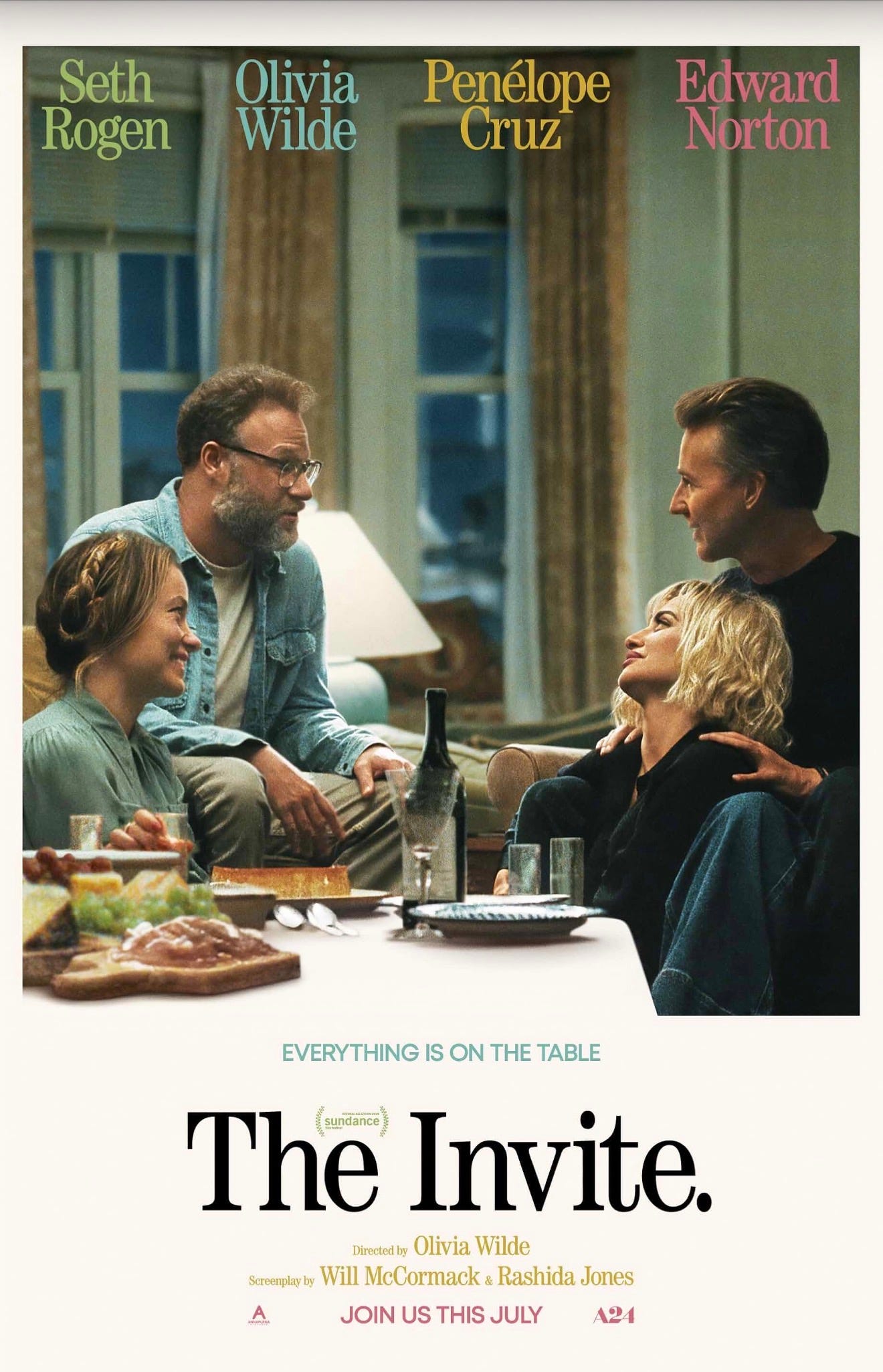
It is a very small film. Nearly all of it takes place inside one recently renovated apartment, with four actors moving through a dinner that keeps slipping out of anyone’s control. It often feels like an actors’ workshop. Wilde, Seth Rogen, Penélope Cruz, and Edward Norton are all exceptionally alive to one another. They listen. They interrupt. They retreat, recover, and lose control again. The film depends on the tiny changes that pass across a face when a joke has gone too far or a private wound has unexpectedly been touched.
Joe and Angela, played by Rogen and Wilde, invite their upstairs neighbors, Pína and Hawk, played by Cruz and Norton, down for dinner. The ostensible occasion is the renovation. The actual occasion is the noise coming through the ceiling from the neighbors’ enthusiastic sex life, which Joe has endured with mounting fury. From that simple premise, the evening keeps opening trapdoors beneath all four of them.
The film is extremely funny. I laughed aloud more often than I have during almost any movie I can remember. The humor does not arise from stupid sex jokes, although sex is the mechanism that sets much of the night in motion. Ok, some of the jokes do. Mostly, they come from recognition. The movie understands how people behave when they are embarrassed, flattered, threatened, or suddenly offered a version of themselves they thought had disappeared. Its funniest moments are funny because they are precise.
The sex is not really the subject. Being seen is.
Angela has arranged a small private performance of her own. There is a window in the apartment hallway visible from Pína and Hawk’s place above. Angela sometimes walks past it naked because she knows Hawk can see her. When this is revealed during dinner, Joe loses his footing completely. He cannot understand why everyone else seems to know something he does not, and within seconds he has invented an entire conspiracy in which the other three people have planned the evening around excluding and humiliating him.
Angela’s admission is simpler and sadder. She likes knowing that someone wants to see her naked because Joe has not looked at her in a very long time.
The window is one of several places where Wilde openly invokes Rear Window. The film does not steal Hitchcock’s shots or congratulate itself for recognizing film history. It uses the reference as a visual language. Windows, hallways, and doorframes keep separating people who are physically close but emotionally inaccessible. The production design and photography are in unusually close conversation. Negative space is not merely attractive here; it is expressive. People disappear into rooms, hover at thresholds, or become isolated inside frames that seem to have been waiting for them.
The same hallway window returns in the film’s final image. At first it frames Angela’s body as an object of voyeurism. At the end, surrounded by darkness, it frames Joe and Angela sitting together at a piano. Instead of a naked woman asking to be looked at, the window holds two people recognizing something in one another that had been lost.
That is the film’s deepest movement: from being looked at to being known.
Joe and Angela have not merely become awkward with each other. They have lost who they once were. The years, disappointments, routines, and accumulated resentments have altered them so gradually that neither seems to have noticed the change taking place. This is not primarily a character study in the usual sense. The circumstances are not there to reveal the people. The people are there to reveal what circumstances can do.
Most stories ask what human beings will do under certain conditions. The Invite asks what those conditions do to human beings. It studies the toll that can be taken on two people living in the same room and sleeping in the same bed while the damage remains nearly invisible to both of them.
That toll surfaces most painfully when the couples separate for a while. Pína spends time alone with Joe while Hawk and Angela move into the kitchen. The film intercuts between the two encounters, allowing attraction, fear, generosity, and self-loathing to rise in different forms.
Hawk tells Angela that she must know how attractive she is. She looks genuinely stunned, as though the possibility has never occurred to her. Then her face turns sour and she says, almost reflexively, “Me? Gross. Barf. I’m just a stupid cunt.” A second later she catches herself and explains that this is only her inner voice. It is how she speaks to herself.
I physically recoiled from the moment. My body seemed to move in two directions at once.
The line is not presented as a revelation engineered for applause. It slips out of her. That is what makes it hurt. Hawk’s brow furrows because he has suddenly heard the private violence she has been living with. He does not need to insist that she is beautiful. He has already done something more important: he has seen the wound beneath her behavior.
I have been both people in that exchange. I have been the person whose inner voice has become merciless, and I have been the person sitting across from someone and realizing with horror how they speak to themselves when no one else is listening. The scene understands that circumstance does not remain outside us. Eventually it becomes a voice.
The score understands this too.
The music appears to be composed entirely for strings, and it does not behave like conventional emotional underscoring. It tracks cognition. Every time the direction, velocity, or acceleration of a character’s mind changes, the strings pull us with it. A feeling comes to the surface, is swallowed, returns, changes owners, and ricochets across the room. The music seems to register the instant before thought becomes speech.
It reminded me of the Disney educational films I saw as a child on a 16-millimeter projector. I could almost hear the machinery running behind me. Those films sometimes used simplified geometric figures and string music that seemed to function as the characters’ thoughts or moral impulses. The Invite uses a similar principle in a sophisticated live-action setting. The strings do not tell us that a scene is sad or tense. They tell us that someone’s interior trajectory has just changed.
This becomes especially powerful during the film’s great explosion. Resentment begins ricocheting off the walls, ceiling, and floor like a psychic boomerang. Joe and Angela attack one another, then recover enough to recognize the inappropriateness of exposing themselves this completely in front of neighbors who are still nearly strangers. One small remark sets everything off again. Even Pína and Hawk snap at each other for a moment, as though the atmosphere itself has become contagious.
Then Pína stops it.
Cruz sits down in the middle of the room and seems to catch the speeding bullet in her hand. She apologizes to Hawk. She apologizes to Joe and Angela. Soon apologies are circling the room as frantically as the accusations had been, and the strings begin moving again. Pína rubs her hands together, settles back into the chair, and gathers the chaos into herself.
She tells them she is not their therapist. Then she tells them what she sees.
She cannot understand how they have sex with one another because they are so mean. There is so much resentment between them. She says it once, pauses, and says it again: there is so much resentment.
Then she gives the film its moral center.
A person does not get many opportunities in life to have a meaningful relationship. Sometimes those relationships come to an end. There will be other opportunities for relationships, and one of them may even be with the same person again. But this relationship, she tells them, is over.
The precision lies in the order of those thoughts. She does not begin with liberation. She begins by acknowledging the rarity and value of meaningful connection. Only then does she say that a relationship may have reached its end.
The distinction is humane and enormous.
Our culture has widely adopted the idea that we do not owe one another anything. I have said those words myself, not in anger but as a way of controlling my own sense of entitlement. Stop, I have told people. You do not owe me anything. We do not owe each other anything.
I am no longer sure I believe that.
Perhaps no one owes us admiration, romance, agreement, or the fulfillment of our expectations. But that is not the same as owing one another nothing. The language of self-care has helped many people leave situations in which they were being harmed. It has also sometimes reduced every ending to individual liberation and every person left behind to something disposable.
Pína completes the thought.
Sometimes a relationship must end. That does not mean the people inside it have become meaningless. It does not mean every possible relationship between them has ended forever. The old form may have become so saturated with resentment that it cannot continue without producing more damage. It has to be allowed to die. Another relationship—perhaps even between the same two human beings—may become possible later.
The relationship is over. The people are not.
That is why the final scene at the piano is so beautiful. Joe has not touched the instrument since he was young and has forbidden anyone else from touching it. After he and Angela have accepted that their marriage is ending, he sits down alone and begins to play. Angela enters so quietly that we do not know she is there until her hand comes into the frame and settles onto the keys beside his. Her ring is visible. They play together.
How many times have we seen one person join another at a piano as a gesture of reconciliation? Many. There are images and resolutions so classical that cinema is allowed to return to them. The question is whether the moment has been earned. This one is.
The scene does not announce that the marriage has been saved. It offers something more delicate. For a few seconds, Joe and Angela are no longer inhabiting the roles that have made them cruel. They recognize the people they once were, and perhaps the people they could still become. They make something together.
Earlier, the noise from the apartment above descended through the ceiling as an intrusion: sexual sound, resentment, and the unbearable evidence of someone else’s intimacy. In the final moments, sound travels in the opposite direction. Music rises from below. The inversion is obvious, and it works completely because every part of the film has prepared it. What rises is not sexual performance but tenderness.
The same window that once framed Angela asking to be desired now frames Joe and Angela finding a way, however briefly, to see one another. If Pína and Hawk were still looking down, they would not be watching a body. They would be witnessing a relationship change form.
Nothing in The Invite is especially new. Films have observed marriages, resentment, aging, desire, and the damage people do to one another for as long as movies have been able to speak. When I was younger, these subjects occupied far more of the cinematic landscape. There were many films about adults in rooms attempting to understand what had happened to their lives.
Familiarity is not irrelevance.
Somebody may object that The Invite breaks no new ground. But if its observations were truly passé, perhaps we would have stopped doing these things to ourselves and each other. We have not. We continue to lose ourselves in familiar ways. We continue to blame everyone within earshot for the person we no longer recognize in the mirror. We still need stories that ask what the years do to us and what we owe the person standing beside us when the damage finally becomes visible.
The Invite did not give me a new philosophy. It returned me to an unfinished one.
For two hours, I felt like a young man in a New York cinema again, sitting among beautiful people in beautiful rooms and listening to filmmakers speak seriously about how a life should be lived among other human beings. I felt that cinema was once again participating in my moral education.
I went into the theater expecting to like the movie moderately. I came out reminded of what I believe we owe each other.