
The Odyssey (2026)
I Just Looked Over My Shoulder and Saw That Death Has Excellent Posture!

Warning: If you have not seen the film, wait and save this article for a joint post-analysis activity. I discuss each episode in detail. Why? Because, if your going to talk about the movie…
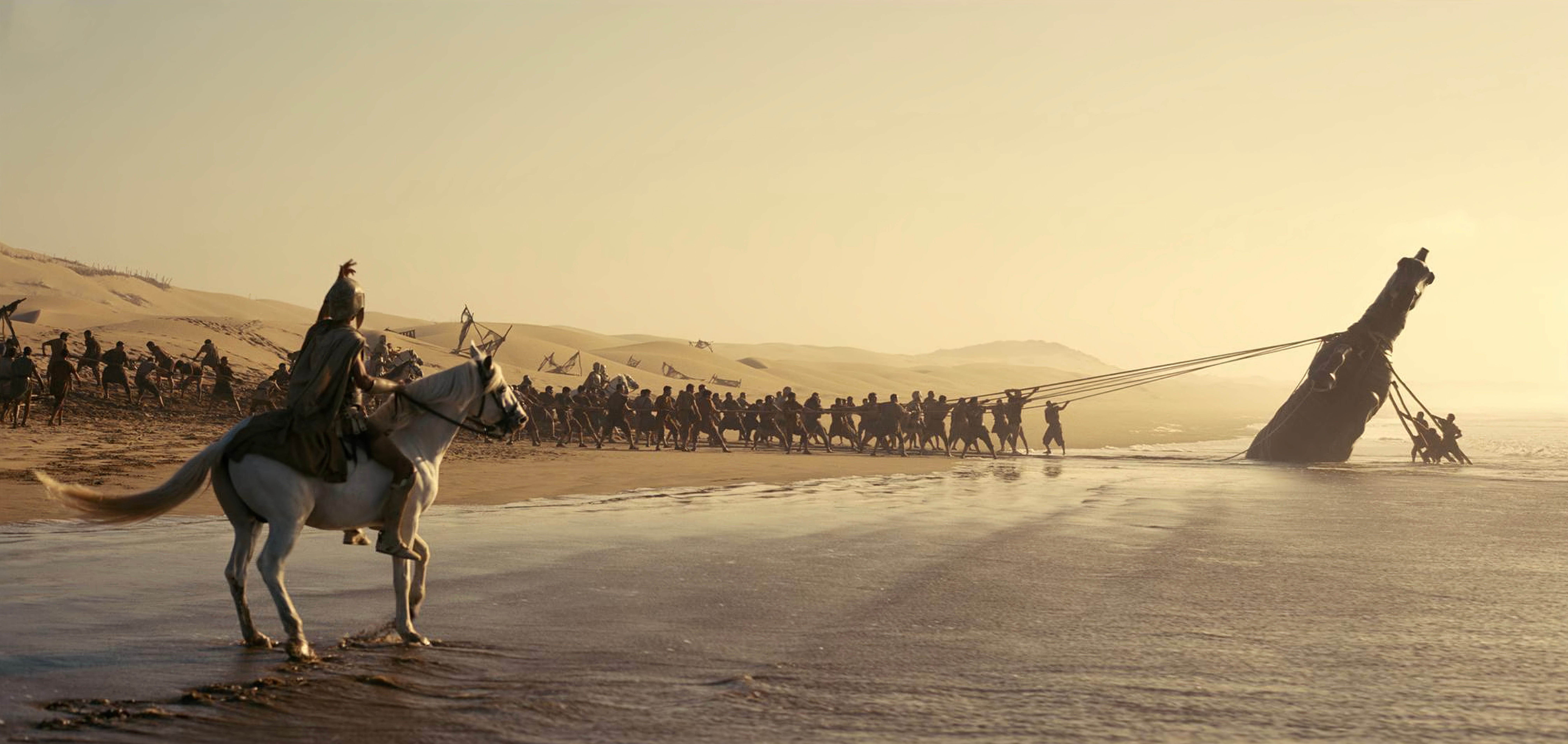
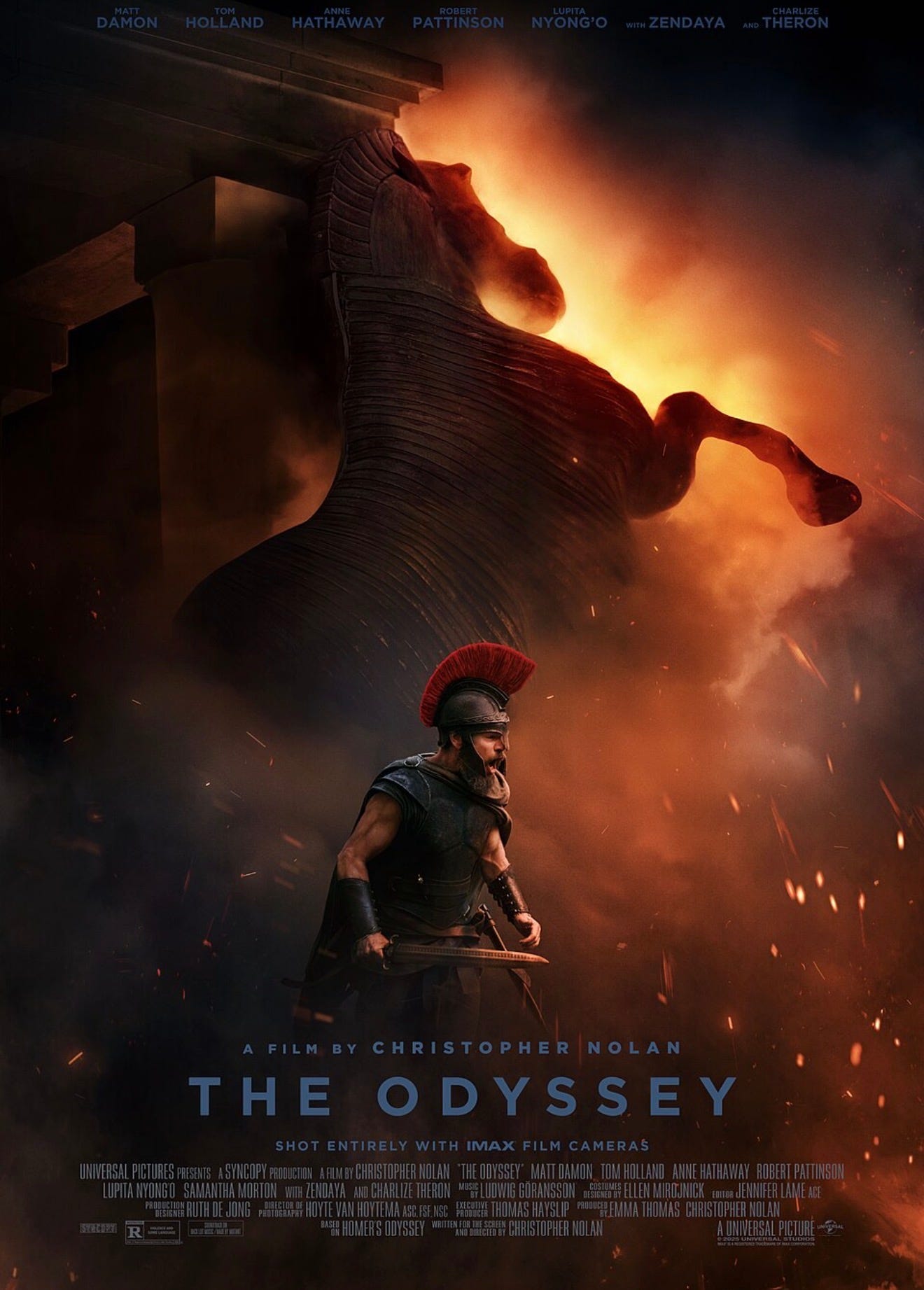
The Trojan Horse possesses no locomotion of its own. It must be dragged inside the walls of Troy.
A mounted soldier watches from the edge of the surf while a line of bodies bends across the beach, every back and shoulder committed to the ropes. At the opposite end, the horse rises diagonally from the water, black against a sky drained almost white by the sun. Its weight is not communicated by its size but by the human effort required to move it. Before it becomes a weapon, a legend, or the most famous deception in Western literature, it is wood, rope, wet sand, muscle and ill-gotten belief.
The image does not announce the scale of Christopher Nolan’s The Odyssey. It establishes its terms. The horse is not simply delivered to the Trojans; they labor to receive it. Their destruction arrives in the shape of a gift, but it can do nothing until they invest their own bodies in the lie. They lean into the ropes. They sink their feet into the sand. They pull it out of the sea and toward the city. Before the horse becomes the instrument by which Troy dies, it has already made the Trojans participants in the act.
That may be the first important thing Nolan understands about Homer: the episodes are not ornaments hanging from an adventure. They are moral mechanisms. Each one asks what a human being will do when hunger, pride, or terror puts pressure on the fragile agreements that allow people to live together. The gods do not impose that question from above. Human beings build the apparatus, take hold of the ropes and pull.
It has been said that no filmmaker has managed to “crack” The Odyssey, as though the poem were a locked container with a story imprisoned inside it. The premise is backwards. The cracking was done approximately twenty-seven centuries ago. The Odyssey is the crack Homer made in the human story, the opening through which fear, fidelity, grief and the longing for home could be seen at the same time.
Nolan did not crack The Odyssey. He walked through the crack Homer made and filmed what is on the other side.
That distinction explains why so many adaptations have felt as though they captured the incidents while leaving the poem elsewhere. They treated the Cyclops, the Sirens, the witch, the whirlpool and the homecoming as the content, then went searching behind them for the meaning. They filmed the vault door and wondered why nothing was inside. Nolan recognizes that the poem is not the obstacle between a modern audience and its material. It is the access. His film functions less as a decoding of Homer than as a universal translator carrying Homer’s decoding across the language gap intact.
Fidelity, in this case, does not mean keeping every incident where Homer placed it. Nolan combines and sometimes replaces. He even relocates it, against every argument, successfully. Such changes are ordinary in adaptations, but the results do not feel ordinary here because they are not merely concessions to duration. Compression often enters a long adaptation as the struggle required to get the source through the aperture. Here the aperture itself becomes an instrument. The film often seems to have been made because a consolidation disclosed something that no intact episode could disclose alone.
The Lotus-Eaters move into Calypso’s captivity. Hermes disappears from the action, but the divine command that he carried arrives as a thunder clap and as Calypso’s fear of what the thunder means. Argos’s final recognition and Eurycleia’s recognition of Odysseus’s scar are drawn into a single gathering of identity. Memories of the Late Bronze Age collapse and the people from the sea are allowed to press upon a poem that survived the darkness following that collapse. These are not economies in the usual sense. They are collisions, and the collisions generate the film.
Even the “law of Zeus,” the phrase under which the film organizes its morality, is a work of convergence. Homer does not hand Nolan a statute bearing that name. Ancient Greek xenia placed reciprocal obligations upon host and guest under the protection of Zeus Xenios; Zeus was also associated with oaths, kings and justice. Nolan gathers those practices beneath one legible title and lets them approach an ethical formulation that later traditions, including Christianity, would express differently as the rule of treating another person as one wishes to be treated. Resemblance is not descent, and proximity is not equivalence. The film does not claim that archaic Greece was secretly Christian. It places moral systems from different centuries near one another and discovers that they illuminate the same human threshold: the moment when another life either does or does not limit what we permit ourselves to do.
This is adaptation as reconstitution rather than reduction. The Odyssey was itself made from inherited song, historical sediment and repeated performance; it reached the page already carrying more than one time inside it. Nolan treats that history not as a barrier around an authorized original but as permission to let the story continue gathering meaning. The film is not fighting the poem into three hours. Its three hours exist to stage the new relations that become visible when Homer, later literature, archaeology, and the accumulated grammar of cinema are allowed to meet.
The result is not modernized antiquity. It is antiquity made present. The film’s language belongs to living mouths. Its men do not speak in the museum English that centuries of costume drama have taught us to mistake for the ancient world. They interrupt, swear, joke, calculate and lie in a register consistent with the world around them. This is not a departure from Homeric tradition but a continuation of it. Homer has always reached his audiences in the language of the people listening. The poem itself was already a work of historical sediment, composed long after the Bronze Age it remembered, carrying different periods and vocabularies within it. A performance varnished with faux archaism would not be more faithful. It would merely be faithful to a more recent convention.
By removing that varnish, the film places the story in our laps. We are not asked to admire the distance between ourselves and these people. We are asked to recognize how little of it exists.
The world Nolan builds is held together by things far less durable than stone. A palace may survive while the understanding that gives it meaning collapses inside it. Penelope makes this clear to Telemachus in the courtyard at Ithaca. The walls are not strong simply because they are built from stone. They are strong only so long as the people who live among them understand what the stone is for, what must be protected within it, and what they owe one another while they stand behind it.
That understanding has a name in the film, though the name is Nolan’s instrument rather than an ancient Greek legal term: the law of Zeus. It gathers the treatment of strangers, guests and suppliants; the obligations running in both directions between host and guest; the sanctity of oaths; the responsibility of kings; and the possibility that the unknown person at the door may be more than he appears. The film does not present the phrase as a quaint custom or an item of mythological exposition. Over three hours, it teaches the gathered principle as case law.
The law is fragile because it cannot enforce itself. It depends upon recognition. A host must see a stranger as someone to be fed and sheltered before he is interrogated. A guest must understand that welcome is not permission to consume the entirety of the house. A king must know that power is an obligation rather than his appetite with a crown placed upon it. Civilization resides in the instant when one person encounters another and decides that the other life imposes a limit. Do these teachings sound familiar? They should. Well touch on that again in a bit.
The Trojan Horse is therefore must be more than just a military trick. It is a weapon made from the shape of hospitality. The Greeks offer a gift while lying in wait inside it. The Trojans bring the offering through their walls. Once that compact can be exploited as a delivery system for murder, the destruction of Troy becomes larger than a victory by one army over another. A bond necessary to the world has been converted into a vulnerability.
The film begins opening this moral ledger before the fleet leaves for Troy. Penelope tells Odysseus that he does not have to honor the oath that calls him to war. He can take his son, his crew, and his boat and disappear. Odysseus knows that Agamemnon will come for him and punish his subjects. To explain what kind of man is approaching, he recounts what Agamemnon did to his own daughter when the gods required a sacrifice. The value of the sacrifice lay precisely in the fact that she was the thing he valued most. Penelope calls the sacrifice monstrous. Odysseus nods in recognition, and then whispers an additional observation, committed.
The war begins with a father spending his child. The journey home will be made by a commander who repeatedly spends other men’s sons in order to return to his own.
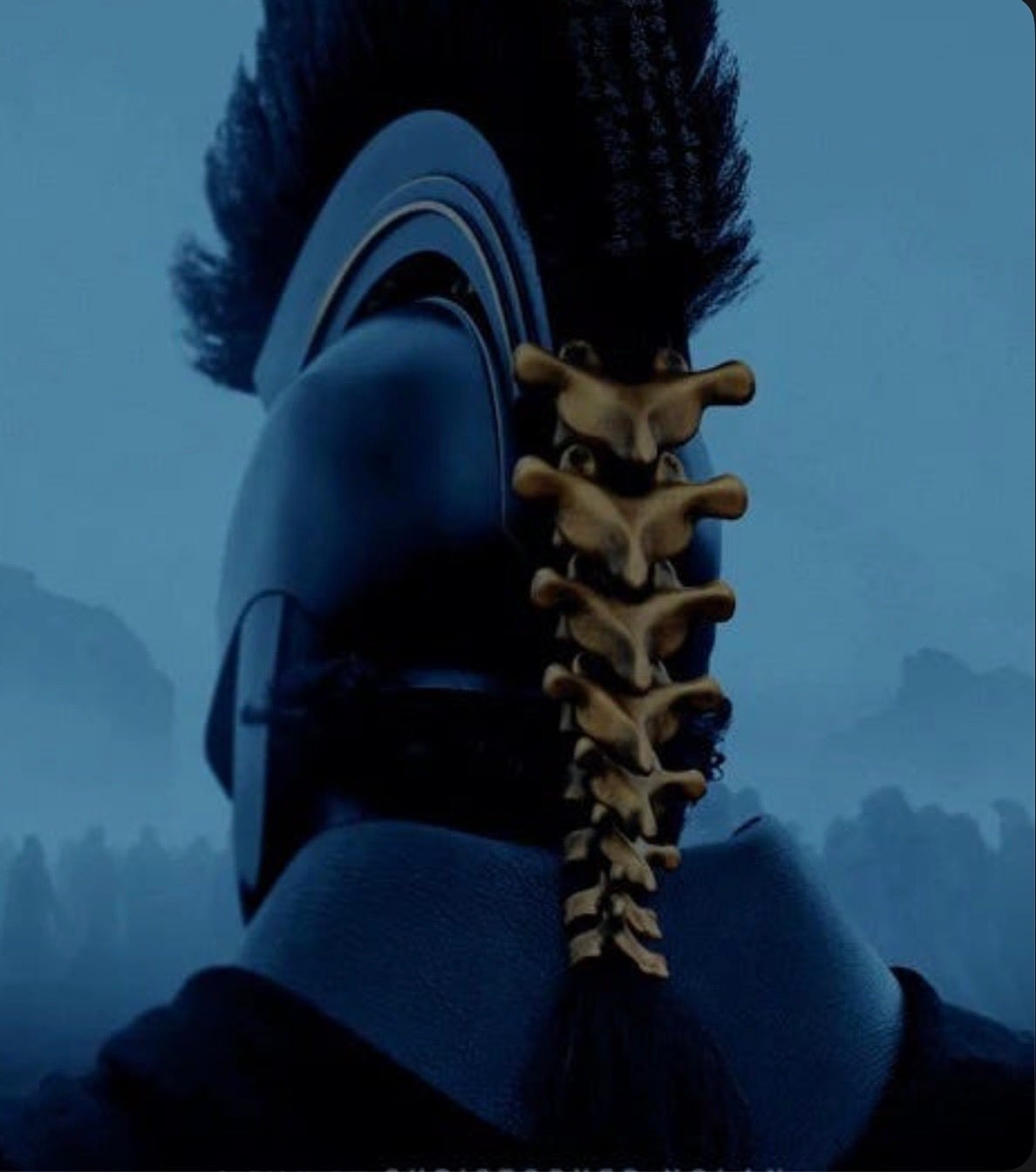
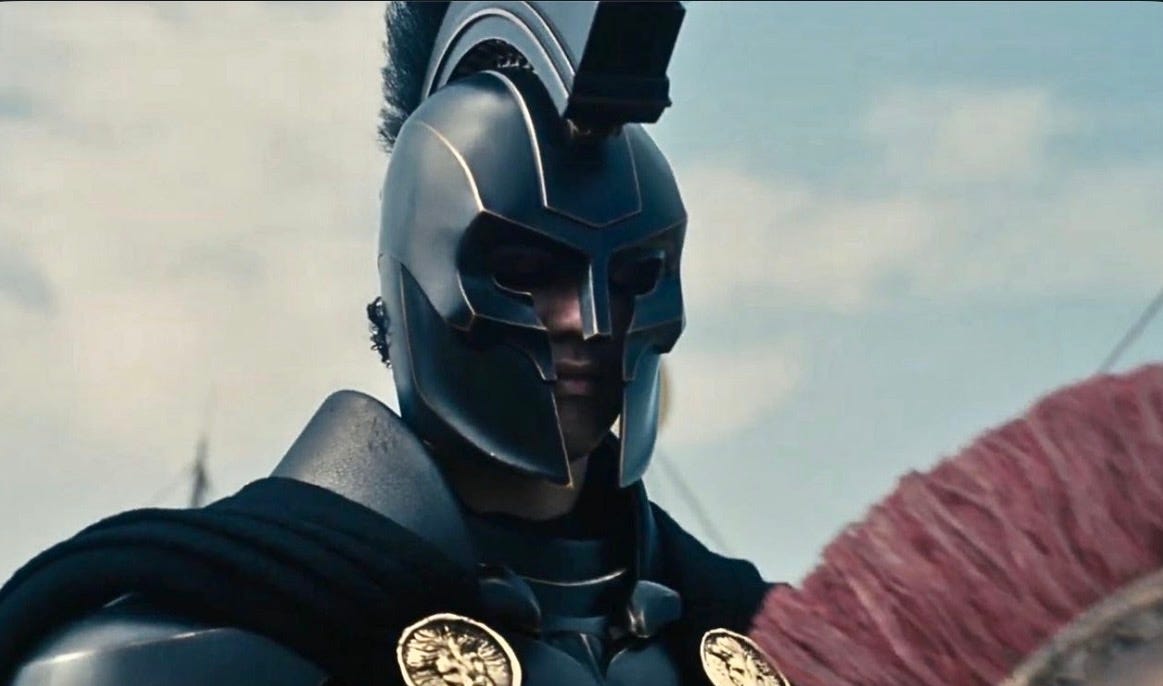
Agamemnon’s battle armor makes this arithmetic visible before he speaks it. It is not quite black. It is an inky blue so deep that fire discovers it only along the pewter-colored edges. A sculpted spinal column runs down the back of his helmet, precious metal externalizing the part of the body that should be hidden and protected. When the gates of Troy open, he stands almost motionless in the darkness while soldiers materialize around him and pour into the city. For a moment he might be a statue, or a scarecrow erected by the night. Then he moves. The army rushes; inevitability lumbers.
Death, the film understands, has excellent posture.
Inside Troy, the compact is broken completely. The city burns. A soldier strikes the stone head from a statue of Athena, and wisdom rolls across the temple floor. Odysseus will eventually accept authorship of this act in a way more consequential than any claim of military victory. He invented the horse. He turned a gift into a trap. He helped burn not only a city but the terms under which one city might open itself to another without committing suicide.
The history surrounding the poem gives that choice an almost unbearable scale. Around the end of the Bronze Age, palace cultures across the eastern Mediterranean burned, trade networks fractured, populations moved and systems of writing vanished from parts of the Greek world for centuries. The causes remain multiple and contested, as causes of civilizational collapse tend to be. The Greeks later remembered marauders arriving from the sea. Nolan does not turn this uncertainty into a lecture or pretend to solve it. He does something more audacious: he recognizes the shape of the memory and makes Odysseus inhabit it. This is a ferociously intelligent choice.
Penelope has warned Telemachus about the people from the sea. By the time Odysseus reaches Ithaca, armed, starved, weather-beaten and unrecognizable, the phrase has changed direction. In the final confession, she asks the beggar whether he is one of them. His answer is yes.
The people from the sea are not an exotic enemy waiting beyond the edge of the map. They are us. They are the survivors of a ruined war arriving on someone else’s beach with weapons in their hands and necessity in their mouths. The film does not alter the episodes to produce this meaning. It moves to the shoreline and looks back at them from the house that sees the boat approaching.
From that angle, the voyage is also an invasion, and the suitors’ occupation of Ithaca becomes the return address of Odysseus’s own history. The armed stranger has come home to find strangers consuming his house. The punishment waiting for them will be determined by the law he violated at Troy. The beggar’s rags are therefore not merely a disguise. They may be the first honest thing Odysseus wears.
The journey between those two violations, the horse admitted into Troy and the suitors admitted into Ithaca, is not a chain of spectacles. It is the education required to make the final judgment legible.
The Cyclops sequence begins not with a monster but with evidence of a household. Bags of cheese age along the damp walls of the cave. Odysseus tastes one and says that it is good. Someone lives here. Someone tends animals, collects milk, makes food and has arranged the cave to preserve it. The details matter because the Greeks have not wandered into an empty lair. They have entered a home and begun consuming what belongs to its inhabitant.
When the Cyclops arrives, he does not stage the entrance of a villain. He passes the men with little concern. A violent gesture draws his attention; he picks up the offending soldier, bites into him with appalling casualness, then lies down among his sheep and sleeps. His indifference is more frightening than rage. The men are not opponents. They are beneath the category of beings with whom a dispute could exist.
After they wound him, he turns away. He cries. He holds his face and calls for Poseidon. The men realize that the sounds coming from him are language. One asks whether they can reason with him. Odysseus answers with the film’s most compact statement of scale: do we reason with ants?
The answer will follow him for the rest of the voyage.
The blinding is not treated as the mechanism by which the hero earns his escape. A wooden stake has been heated in a fire and driven into a living eye. The Cyclops does not absorb the injury and resume his function as an obstacle. His enormous body bucks against the ground. The sound of it striking the cave floor travels through the auditorium with the force of wreckage that is bursting with pain and yet unaccounted loss. This creature only has one eye. Watching the monster writhe is like watching a shockwave travel through a landscape.
The scene refuses the mercy that action films customarily extend to an audience once the decisive wound has been delivered. It remains with the body. On the hillside and into the sea, the Cyclops follows not as though pursuing revenge but as though pursuing the possibility of relief. He leans against the rock because pain has made standing impossible. He enters the water holding his ruined face. By the time depth and exhaustion stop him, the debt has already passed from the son to the father. Poseidon’s sea will remember what happened in this home.
The film’s visual methods become inseparable from this moral effect. A creature may be convincing in the cave where it was designed to exist, then lose its constitution when it steps into daylight or water. Here it crosses every boundary without shedding reality. Cave, hillside and sea exert different demands upon mass, texture, light and movement, yet not one environment exposes the join. Practical construction and digital work cease arguing about which deserves to be called real. The effect is real because the suffering remains legible wherever the body goes.
Even the escape beneath the sheep is reimagined according to that principle. Instead of hanging tidily from their underbellies, the men fasten bundles of wool, dander and sticks across their backs and crawl from the cave on all fours. If the blinded hand descends, it will encounter the tactile lie of a sheep. The new image contains the old one. Nothing is discarded; something is gained. Homer’s device survives, but it now has weight, odor, labor and panic.
The Cyclops is the first decisive lesson in the film’s law because every position within it is compromised. The men are intruders. The creature is a host who does not recognize guests as moral beings. Odysseus meets the failure of hospitality with mutilation and deceit. No one leaves the cave innocent, and the sea itself takes jurisdiction.
The Circe sequence is where the film’s adaptive method becomes impossible to mistake. It is not an interlude between monsters and the underworld. It is the midpoint, the prosecution and the prophecy: nearly the whole moral argument of the film conducted by two people, a knife, a table and a door that will not stop shaking.
Odysseus’s men reach the island after the surviving crew has come as close to mutiny as it yet has. Their ships have been destroyed; confidence in their captain has thinned to almost nothing. The men insist upon making the search while Odysseus remains behind, and the company divides. The arrangement is more than practical. The same test will now be run in opposite directions. One half will enter a house and become prey. The other will go hunting and discover what its prey contains.
The approach to Circe’s house carries the cinematic memory of Pleasure Island in Pinocchio, but lightly enough that the scene never stops to admire the resemblance. Large cats occupy the rising ground around the house: dangerous bodies made docile, displayed rather than posted as guards. Nothing appears to threaten the visitors. Food is visible. Shelter is waiting. The men are not captured; they are invited. That is the grammar of voluntary dehumanization. The body becomes animal only after appetite has already accepted the terms.
Nolan has prepared the other half of the sequence through a detail of Odysseus’s hunting ritual. Before he releases an arrow, he plucks the bowstring. The sound warns the animal. It is a small, almost ceremonial fairness granted by the hunter to the life he intends to take, a form of xenia extended across species. The animal is given the dignity of knowing that death has entered the field.
That courtesy also contains an indictment. Odysseus will warn a gazelle before he kills it, but he entered Troy inside a gift. The Horse was a hunt with no twang. (Don’t quote me on the gazelle, I’ve seen it four times and I’m still not sure.)
Inside the house, the men complete the argument before Circe has to make it. The table already holds more food than its apparent inhabitants could need. Soot has darkened the walls more heavily as it approaches the ceiling, making years of fire and cooking visible above them. The house is not an abstract witch’s lair. It has duration. It has been feeding visitors for a very long time. No one asks who the food was prepared for or what previous guests have become.
Circe does not initially meet them as a predator. When she discovers armed men inside, she screams. They pursue her through the room, seize her and then begin reassuring her, talking themselves into the role of guests before she has offered it. The hospitality they claim has already been obtained by force. When she tells them that she has plenty to feed them, the smallest alteration in her expression is enough. Samantha Morton can appear warm while keeping the motive behind the warmth entirely unavailable. The trap works because the audience cannot decode her any faster than the men can.
They descend upon the meal. Their eating supplies the transformation before any magic does. By the time Eurylochus asks the right question, why so much food should be waiting in an isolated house, the men have already made themselves into the creatures the scene will reveal. Circe moves among them with a tenderness that seems almost maternal. She brushes hair aside. A pig’s ear appears. The transformation is not imposed as a punishment from outside. It is uncovered.
The editing makes that idea physical. The film refuses the continuous digital metamorphosis through which one body smoothly becomes another. A human hand is followed by a hoof; a mouth by a snout; skin, bristle, fingers and trotters are assembled through cuts. The process exists nowhere as a single image that can be inspected and disbelieved. Rhythm makes the spectator perform the transformation. Cinema does not illustrate the magic. Cinema is the magic.
At the same time, Odysseus’s arrow finds the animal he has warned. The gazelle falls. When he reaches it, the body has become a man with an arrow lodged in his shoulder. The two halves of the divided company have arrived at the same event from opposite directions: men are disclosed as animals in the house; an animal is disclosed as a man in the field. The wound is survivable, which matters. Odysseus cannot convert the event into an accidental corpse and move on. He must confront the living human consequence of an honorable rule that could not see what it was aiming at.
The scene therefore does not simply borrow Homer’s swine and invent a parallel flourish. It finds a cinematic structure latent in transformation itself. The cut between man and animal becomes a method for asking whether the distinction was ever stable. Circe’s claim is that she has not degraded these soldiers but removed their disguises. The hunt answers that a man can also be concealed inside the creature to which a hunter has granted only a limited courtesy. In both directions, the eye has mistaken appearance for moral category.
When Odysseus reaches the house, the cats let him pass. Circe is feeding the pigs. She greets him as a stranger and asks whether he is lost or has come from the sea. He is both. The question plants the phrase that Penelope will use in Ithaca, where “the people from the sea” names the civilizational threat waiting beyond the walls. Circe has recognized the threat at her own door before Odysseus understands that he belongs to it.
He lies that he is alone. She never does. Their encounter proceeds as a duel conducted through food. He acknowledges hunger without speaking it; she discovers that speech is what she wants from him. She invokes the hospitality of Zeus while preparing a meal that may have been made from visitors, then proposes that one of the pigs be butchered to complete the feast. The guest would be made to kill and consume his own man. The Horse is returned to him in domestic form: a host offers a gift that turns its recipient into the instrument of the harm concealed inside it.
The pig escapes his grasp, and the failure saves them. He sets the knife aside and proposes that the stew already on the fire will be enough. She warns him about the meat. A crow attempts to warn him too, and Circe silences it by feeding it the very substance against which it is protesting. Later the crow will be identified as her sister, caged because companionship becomes easier after the other person’s freedom has been removed. The joke does not puncture the world. It completes the household: another home in which affection has learned to call captivity practical.
At the table, Circe asks why a guest has carried a dagger into her house. Her accusation is accurate. So is the obscenity of hearing it from a host whose rooms consume guests. Odysseus cannot deny the law merely because the person invoking it is violating it. He surrenders the blade. The man who built the Horse because hospitality contained no rule about hollow wooden animals now gives up his knife because the law does contain a rule about weapons in a host’s home.
This is one of the film’s deepest understandings: moral language does not become false when spoken in bad faith. The Cyclops can possess a household and fail every duty of a host. Circe can name the guest’s obligation while turning guests into livestock. The suitors can depend upon the protection of hospitality while devouring the house that provides it. Everyone understands the law well enough to use the part that protects his own appetite. Civilization fails not because its rules are unknown but because people become virtuosos at applying them in only one direction.
Circe then prosecutes the men themselves. She describes what soldiers do beneath the disguise of manhood: the women, the children, the villages, the provisions taken at the order of kings and renamed honor. The film’s history has supplied her evidence. Troy is still burning inside the argument. She is not wrong about these men, and the scene does not rescue the audience from that fact merely because she has done something monstrous to them.
Odysseus asks whether they harmed her. They did not, she concedes, but they would have. Her verdict is preemptive. She has recognized a true danger and punished an act before it occurred. The question at the table is therefore harder than innocence against guilt. How much truth about a person is required before fear may act as judgment? Is exposing what someone has been the same as proving what he would have done here? Circe sees the men clearly and still crosses a moral boundary in the act of preventing them from crossing it.
Odysseus does not defeat her prosecution by disproving it. He asks her to let them go home. He pleads the want. That plea brings the entire poem into the room. Does the desire for home confer a right to return after the things one has done in pursuit of it? Can longing serve as evidence of a remaining humanity, or is it merely another appetite asking to be exempt?
All the while, the pigs hammer and squeal beyond the door. The sound has been accumulating through the scene, ignored by both people because the argument at the table is more dangerous than anything trying to enter it. Then the door gives. The pigs flood the room. Circe drops the knife and sits down. The noise stops.
They do not attack. They gather around the table as witnesses. The host finally occupies her own chair, weapon lowered, while the guests surround her in the form she says is true. The house is forced into the arrangement it has evaded: host and guests together, neither category safely hidden from the other.
Only then does Odysseus ask for the knowledge required to continue. Circe’s answers arrive in a descending series. The trade routes are beyond his reach. He must find the place where fire and ice meet. That place is Hades. He will enter and return. His men will not. The gods have spoken, and his men do not want him to challenge them.
Odysseus answers that he will defy the gods.
The line is not a slogan announcing heroic independence. It is the exact moment a commander is told the price of his own survival and refuses the arithmetic. He calls the refusal loyalty: he will not permit his men to die. But the prophecy includes their will, not merely their fate. They have already challenged his leadership on the beach. Now he is told that obedience may spare them and defiance will destroy them, and he chooses defiance over their objection. He goes to Hades to find the way home for his men, and the going is what carries them toward their deaths.
The terrible paradox is that the same faculty will save him. The thing that gets Odysseus home is the thing that kills everyone who follows him there. Circe is the film’s other Athena, asking the question of consequence before the decision instead of after it. The whole back half of the voyage, Hades, Scylla’s six, the cattle of the Sun, the storm, works out the sentence delivered at this kitchen table and refused.
Circe finally yields on the bodies while conceding nothing in the argument. Dressed in black, she moves into the flock and bends over each animal, touching it lightly and singing as though putting a child to sleep. To a modern eye the iconography is almost devotional: the accuser becomes shepherd, healer and figure of mercy. Yet what she offers is not, in her understanding, restoration. She calls the human form a disguise and returns each man to it. The film gives its most unsparing prosecutor the most tender action in the sequence and refuses to make either truth cancel the other.
The reverse transformation is again created through fragments. Hooves become damaged-looking hands and straighten. Bristles surrender to skin. The men reappear not with the triumph of a spell broken but with the discomfort of people being dressed again in a shape whose innocence has been denied.
When Eurylochus asks whether Odysseus intends to let a witch live, Odysseus points toward the same divine order he has just promised to defy: the gods gave her the power. Killing her would place another violation inside the attempt to repair the first. This is not a continuity error in his morality. It is the portrait. He will break the gods’ command to preserve his men and cite divine authority to preserve the stranger who held a blade to his throat. He applies the law inconsistently and sometimes beautifully, which is another way of saying that he applies it as a human being.
Circe’s episode in Homer already contains the unstable house, the offered meal, the transformation, the restored men and the command to descend to the dead. Nolan has not replaced that structure. He has allowed it to gather other structures around it: the cinematic memory of voluntary transformation, the Horse recast as food, the people from the sea, the one-sided invocation of law, the hunter’s warning, preemptive judgment, Christian-looking mercy and a prophecy whose refusal generates the rest of the voyage. The result is not Homer simplified. It is Homer made newly relational.
This is why the sequence feels like the reason for an adaptation rather than the damage required by one. Its consolidations do not apologize for what three hours cannot contain. They demonstrate what three hours can discover.
In Hades, the film turns Circe’s prophecy into geography.
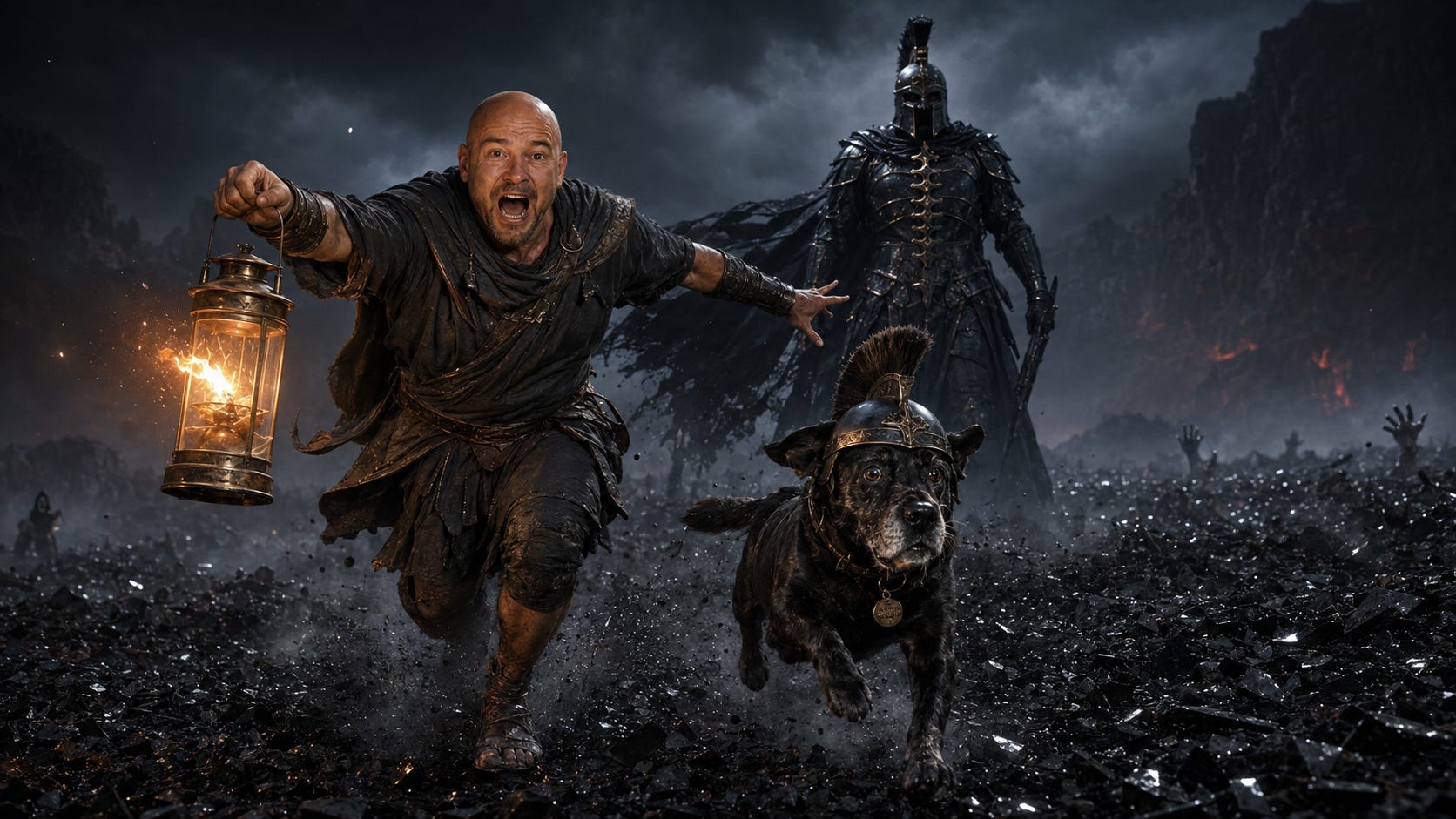
Odysseus has been told to find the place where an icy river meets a fiery one. He and his men arrive at a plain of black igneous rock extending toward the horizon, its surface glittering as though crushed glass had been mixed into the earth. A solitary plateau anchors one edge of the image. The location is impossible and unmistakably terrestrial. It looks not like a fantasy of the underworld but like a part of this planet that has been left unattended by the living.
They place a shield on the ground and fill it with the blood of sacrificed sheep. An instrument designed to turn aside blood becomes the vessel that offers it. The dead emerge around it in fragments: hands covered in black glass, helmets and plumes rising through the soot, faces marked with a mineral residue that seems too adhesive ever to be washed away. The riches of a European opera house could not make the image more opulent. Everything is black, but nothing is empty.
The dead must drink before they can speak. Nolan does not present this as an antique rule whose strangeness we are expected to accept. The performers make thirst the scene. They approach the shield as though approaching sacrament. Blood reaches the mouth; the body remembers language; words fall out.
What Odysseus receives is not prophecy in the simple sense of privileged information about the plot ahead. It is testimony from the consequences he has already made. Among the dead is Agamemnon, the commander whose armored spine once moved through Troy without urgency. His lesson is brutally practical: do not return home as a king expecting the welcome owed to a king. Agamemnon trusted the ritual of homecoming and was murdered within it. Return as a stranger. Discover whether your house still knows the law before you place your life inside its care.
This counsel authors the final movement of the film. Odysseus does not think of the beggar only because he is the clever man who can invent another disguise. He has been taught by a dead king to make his own home reveal itself. The journey is not merely testing his endurance; it is creating the method by which he may survive his arrival.
The dead also change what it means for Odysseus to continue. The men he has lost are not abstractions contained in a commander’s arithmetic. They remain available as accusation. Sons entrusted to him stand in the earth because his home mattered more to him than theirs. Every subsequent decision is made in their presence, whether or not he can see them.
That presence becomes intolerable when the voyage reaches the Sirens.
The film withholds their song. The men place wax in their ears, and the audience receives the world through their altered hearing. When Eurylochus seals one ear, the auditorium dulls on that side with a physical thud; when he seals the other, the enclosure is complete. The change resembles the instant when noise cancellation engages or pressure clears inside the head, except that here the world closes rather than opens. The room itself seems to acquire wax.
Odysseus has ordered himself tied to the mast because he wants the impossible distinction of being the man who heard and survived. This is not simple curiosity. It is the appetite that has governed him from the beginning: the belief that sufficient cleverness can allow him to possess an experience without submitting to its cost. The ropes preserve his life while preserving the fantasy of control.
What the Sirens offer is not beauty so much as terror. Their song gives voice to the thing a person believes he wants more than anything else, then makes him understand that he does not truly want it, or that possessing it could never give him what he has asked of it. For Odysseus, the horror is larger than being detained on the journey. They threaten the meaning of home. They suggest that the desire sustaining him is false, that Penelope and Telemachus cannot release him from the person the war has made, and that Ithaca may be only the name he has given his refusal to stop.
The Sirens offer knowledge, but the knowledge is a lie.
The final movement of the film will prove it. Home has not been emptied of meaning. The bed, the dog, the wife and the son retain what the song declares impossible. The lie works because it fastens itself to something true: Odysseus cannot return as the man who left. He hears that truth and mistakes it for the conclusion that return itself is fraudulent.
The men cannot hear the argument, but they can watch what it does to him. One sailor becomes fascinated by the violence of Odysseus’s response. He removes the wax from his own ear, as if the spectacle of another man’s suffering has made the forbidden knowledge more desirable. He goes mad almost immediately and throws himself into the sea. Odysseus is not the only person who wants to be singular. His vanity is contagious.
It is also lethal. At the strait, Odysseus knows that Scylla will take six men. He does not tell them. He has judged that the alternative will destroy the entire crew, and the calculation is comprehensible. Six lives are spent to preserve the remainder. But comprehension does not absolve it. When the survivors discover what he knew, the word from the cave returns with reversed force. The commander who rejected the idea that human beings could reason with the Cyclops has made himself the larger creature. He has looked down upon six men and decided what number of ants the passage requires.
The film never allows leadership to become a decorative word for making other people absorb one’s decisions. Odysseus suffers with his men, loves them and means to bring them home. He also lies to them when their consent would interfere with his judgment. His love does not cancel the structure of power. It makes the structure more painful.
The last oath of the crew is made on the island belonging to the Sun god. Odysseus tells them plainly that they must not kill the cattle. They swear they will not. For a long time they keep the promise. Then the wind refuses to rise, their provisions disappear and hunger begins rewriting the agreement.
When Odysseus finds them eating, their explanation sounds like reason: they have decided they would rather drown at sea than starve on the island. This is how oaths are usually broken, not by announcing that fidelity has become inconvenient, but by constructing a circumstance in which betrayal can be renamed necessity. The reasoning is not false. Starvation is real. That is why the permission works.
Athena gives Odysseus no room to pretend the warning was obscure. Fire, pain and death require no translation. Asked whether he sees choice or consequence in what stands before him, he chooses consequence. He is furious because he knows the judgment is correct, and because the men’s choice resembles too many of his own.
Then the wind arrives.
The same force withheld while the oath was tested returns as an escort to the sentence. Odysseus tells the men that if they prefer drowning, their opportunity has come. They launch into Poseidon’s sea beneath Zeus’s sky, and the storm destroys them one after another while their commander stands unable to convert knowledge into rescue.
This is where the film makes faith useful without making the gods kind. The moral order is severe, jealous and sometimes appalling. It is not offered as proof that the universe loves human beings. Its value is legibility. The world has limits. Warnings can be understood. Choices produce consequences. Desire does not become authority merely because the desire is desperate.
The comfort is not that good people will be spared. The comfort is that events are not shapeless.
Odysseus wakes beside Calypso after the storm, though “wakes” is too generous a word for the state in which she has kept him. Seven years have passed. He eats lotus and lives within a happiness whose most important condition is that he cannot remember what it has replaced.
In Homer, the Lotus-Eaters and Calypso belong to different episodes. Nolan joins them without flattening either. The lotus moves to Ogygia; Hermes disappears; the Sirens, the flower and the beautiful captor become successive expressions of the same temptation. Do not go home. Do not remember. Do not submit to consequence. Let relief become the destination.
Calypso’s defense is not invented from nothing. Odysseus arrived nearly dead on wreckage. She gave him the flower so that he would suffer in body without suffering in mind while she nursed him. An anesthetic became a habit; care became love; love became the justification for maintaining the condition that made departure impossible. No single step required her to name herself a captor. Captivity accumulated inside a series of merciful decisions.
That is what makes the sequence dangerous. Calypso is not a Siren in the genealogy of the gods, but the film makes her temptation an extension of their song. She does not tell Odysseus that home is meaningless. She gives him a life in which the question can no longer occur. Forgetting does not argue against Ithaca. It removes Ithaca from the field of argument.
When she asks him to stop eating the lotus, he answers with the simplicity of an addict defending the object that has organized his body: he loves it. Memory returns slowly, then all at once. He asks what happened to his men. She tells him he already knows. He asks whether he had a wife and a family. Shame enters her posture before the answer enters language.
Calypso insists that they were happy. Odysseus answers that she was happy. Both claims contain truth. Their life together was not theatrically false. Affection, pleasure and years of shared existence do not vanish because their foundation was coercive. The film is more exacting than that. It allows the happiness to have been real while refusing to let its reality repair the theft upon which it depended.
It also refuses to make Odysseus entirely passive. Calypso reminds him that he continued eating even when she began encouraging him to stop. For some period, he was unwilling or unable to remember. Her admission redistributes guilt without equalizing it. A person under enchantment may still participate in the enchantment; participation does not make the terms free.
There is no messenger arriving to order his release. Thunder speaks where Hermes once did. Calypso understands. She wraps herself tightly in a shawl or net, holding her arms against her body as though she must bind her own desire before she can free him. In the background, Odysseus reconstructs a raft from the remains of his ship.
Her final instruction overturns everything he believes makes him capable. He is a man who needs to control the outcome, but the only way home is to relinquish control. He must give himself to Poseidon and take his punishment.
The ropes return. At the Sirens, Odysseus used them to experience surrender while remaining protected by command: bind me, ignore what I say, preserve me from my own desire. On the raft, he binds himself so that cleverness will no longer be available. The strategist’s final strategy is to make strategy impossible.
He throws himself into the sea.
Water enters his nose and mouth. The raft rolls through the tempest. He appears to drown, and the screen goes black. When his eyes open, he is lying on a pebble beach. Athena sits beside him and asks whether he does not recognize his own home.
Ithaca has remained where it was. Odysseus is the variable.
The last forty-five minutes are not an epilogue attached to the voyage. They are the reason the voyage has taken three hours.
The film has taught the law through repetition, violation and consequence. It has shown a gift turned into a weapon, a household invaded, a host who cannot recognize guests as people, a prosecutor who sees men truly and punishes them in advance, a commander who spends the lives beneath him, an oath revised by hunger and a love that calls captivity happiness. Now it presents another occupied house and asks the audience to render a verdict without being handed a new set of instructions.
Odysseus enters Ithaca as the person most protected by the law of Zeus and most dangerous to anyone who breaks it: the stranger at the door.
The suitors have already made their position clear. They have converted Penelope’s home into an inexhaustible table, treated Telemachus as a child whose inheritance can be consumed in front of him, and mistaken the duration of their trespass for permission. Their offense is not that they seek a widow’s hand. It is that they have eaten the distinction between courtship and occupation. Like the soldiers on the Sun god’s island, they have manufactured an argument in which appetite acquires the appearance of right.
Argos lies outside on a dung heap. The dog has become so old and infirm that loyalty can no longer be made attractive. The suitors have attacked him and cast him from the palace against the wishes of Penelope and Telemachus. This is one of the film’s quietest and most complete judgments. A household that expels the creature who kept faith has already announced what it will do to the human stranger.
The lotus offered forgetting as relief. Argos is its opposite. His body is memory after memory has ceased to be useful. He has carried recognition for twenty years without reward, and he remains alive for the instant in which it can be returned.
Odysseus approaches him in the beggar’s clothes and kneels. There is no sentimental swelling around the act. He places his hands on the dog, and Argos dies. The touch is enough. Telemachus sees it and understands what he has not been told: the stranger is his father.
The film consolidates two ancient recognitions without reducing either. In the poem, Argos survives long enough to see Odysseus, and the scar on Odysseus’s leg reveals him to the old nurse Eurycleia. Here the dog’s death and the scar participate in the same gathering of identity. Recognition spreads not through announcement but through the things that cannot be counterfeited: how a hand knows an animal, and how a wound remembers a body.
Penelope’s recognition is the most demanding because she requires more than proof that the traveler is Odysseus. She must learn what kind of Odysseus has returned.
She empties the hall and summons the beggar. A screen stands between them. He sits with his back turned while she brings her ear close to the partition. The staging resembles a confessional, though neither person can yet afford the comfort of naming it one. He tells her what happened at Troy. She listens to a stranger describe her husband’s crime.
When he accepts responsibility for the horse and the burning of the city, Penelope offers him an alibi. It was not one man, she says in effect; all of them did it. Odysseus refuses the distribution. The idea belonged to one man.
This is when she knows him.
The recognition does not arrive because he remembers a private object or supplies a fact unavailable to an impostor. Those proofs will have their place. What identifies him first is the shape of the burden. Penelope knows the man she married well enough to recognize the exact guilt he would claim if twenty years had stripped away his defenses. He proves his identity by refusing to become smaller than what he did.
The confession reaches beyond Homer for language large enough to hold the act. Odysseus understands the burning of Troy as though burning one world were the burning of the world entire, a moral arithmetic associated with another ancient tradition, in which the destruction of a life carries the weight of destroying a world. As he speaks, the film returns to Troy and shows a soldier cutting the stone head from Athena’s shoulders. The image does not decorate the sentence. It completes it. Odysseus did not merely devise a way through a wall. He made wisdom itself collateral to victory.
Athena appears beside him as he confesses, weeping. When he reaches toward her, she disappears. The film does not reduce the gesture to a message that forgiveness has been granted or withheld. Divinity remains present and unavailable. What matters is that Odysseus can finally speak without using the goddess as an explanation for his own mind.
This is also why Penelope can never be an obstacle to his destiny here. She is the destination before which destiny must account for itself. Her twenty years are not a delay in the hero’s story. They are the fixed moral position against which his movement can be measured.
Anne Hathaway plays that position through restraint. The familiar forward brightness in her screen presence has been drawn inward. Penelope is not inactive; she is holding. Her clothing lengthens and confines the body at once. Intricate rings of metal encircle and visually extend the neck, giving her the beauty and discomfort of a person required to preserve majesty while her house is dismantled in public. The aging of her face is not a flourish of chronology. Time has been made part of the performance.
Tom Holland’s Telemachus begins with a boyish eagerness that other films have often used as the whole of his appeal. Here it becomes material that must be outgrown. He is the son of an absent man, surrounded by adults who benefit from treating him as permanently unfinished. His movement into adulthood cannot consist of imitating the legend he has inherited. It begins when he recognizes the exhausted stranger underneath it.
Zendaya’s Athena speaks in the same modern register as the mortals and is made more divine by the lack of ceremonial distance. She can walk alongside Odysseus, correct him, challenge the stories he tells himself and disappear without the film changing dialect around her. She is a familiar presence but not a soothing one: the anti-Siren, offering the truth that returns him to consequence rather than the knowledge that excuses him from it.
The women who remain at the edge of this story remain there because the architecture belongs to a particular return, not because the film is required to manufacture an independent history for every figure who crosses the frame. What matters is what the structure asks women to be. Nolan has often arranged women as the cost of a man’s calling, the person whose need interrupts the pure completion of his purpose. That arrangement is absent here. Penelope is not the life Odysseus must escape in order to become fully himself. He has escaped her for twenty years. His fullness depends upon becoming answerable to her.
The trial begins with the bow.
Penelope introduced it earlier when she offered it to Telemachus. He refused on the grounds that only his father could string it. Her answer exposed the contradiction: he had been willing to let others try. Reverence had become another way of leaving authority unattended.
Now the bow becomes the instrument by which the house identifies its rightful order. The suitors approach it as they have approached everything else in Ithaca, as an object temporarily resisting possession. They fail because strength is not the only condition. The bow belongs to a history of body, practice and obligation they cannot inherit by standing near it.
When Odysseus takes it, the film does not suddenly abandon the law for the pleasures of revenge. The slaughter is the verdict produced by everything that came before. The suitors were given a house and treated it as prey. They saw an old dog and punished fidelity for becoming inconvenient. They encountered a beggar and made contempt their answer to the possibility of a god in disguise. They fail the test before the first arrow is loosed.
That does not make what follows clean. The law that protects the stranger also demands the death of the traitor. The women of the household who joined the occupation are not excused by the film’s modern audience or by its hero. The story refuses to soften itself into a morality whose only purpose is to reassure us that our sympathies are humane. Its order is older, harsher and internally coherent. Nolan neither celebrates that severity without remainder nor apologizes for allowing it to remain. He makes us stand close enough to feel what the law costs when it ceases to be an idea.
This is the morality that gives the film its uncommon altitude. For three hours, it asks human beings to imagine themselves as creatures capable of obligations larger than preference. It does not flatter us by pretending we usually occupy that height. Nearly every disaster in the film begins when someone produces a reason why this appetite, this injury, this emergency or this love should be exempt.
The Horse says a gift may contain murder. The Cyclops says a home without recognition becomes a feeding place. Circe says accurate judgment can become an atrocity when fear carries it past the act and into the person. Scylla says arithmetic does not stop being blood because a leader performs it. The cattle say need can explain a betrayal without making it fidelity. Calypso says love can be real and still become imprisonment. Ithaca says a house remains a house only while its inhabitants understand that welcome has limits and power has duties.
Odysseus is qualified to judge the suitors because he has violated nearly every law under which they stand. Not because the violations makes him righteous, but because return has made denial impossible. He arrives at his own hall as both executioner and evidence.
The film’s scale matters, but not in the way scale is usually sold. Large-format cinema is often treated as a synonym for physical magnitude: a larger screen for larger armies, larger storms and larger creatures. The Odyssey uses its immense image to make small things exact. Ropes tighten against hands. Wax seals an ear. Blood gathers in the shallow bowl of a shield. Fire finds the raised edge of dark armor. A dog recognizes a palm.
Nolan shot the film entirely with IMAX cameras, and the fidelity survives even when the exhibition is not IMAX and not film. The screening in which the film first revealed itself to me was digital Cinemark XD, not 70mm. That distinction matters. Capture and exhibition are not the same thing, and no logo on a ticket can guarantee that the room will honor what was photographed. The image in that auditorium was luminous, stable and large enough to hold the compositions without turning them into architecture one had to inspect by moving the head.
That last condition is essential. Seeing this film small would diminish it. Seeing it on a screen so vertically imposing that the relationships within the frame cannot be apprehended would diminish it more. The relevant axis is not size but legibility. The Horse matters because the mounted figure, the line of laboring bodies, the wet sand and the diagonal wooden mass can be understood at once. Immersion that destroys composition is another form of blindness.
Sound is less negotiable. The auditorium must be calibrated well enough for pressure, direction and absence to become part of the narrative. The two sealed ears at the Sirens do not merely illustrate what a character hears; they reorganize the spectator’s body. The Cyclops striking the cave floor is terrifying not because the volume is punishing but because the sound gives pain mass. When the blood-red sail unfurls at the beginning of the voyage, ropes, rings, timber and wind make departure mechanical before music can make it romantic.
That sail is the image to which the film keeps returning in memory. Men pull. The breeze enters cloth. Rings travel along the yard, the ropes take weight, and the red surface rises against an ocean only angry enough to suggest what it will later become. Cinema has sent innumerable heroes to sea with a flourish and a jaunty promise of adventure. Here departure is a machine human beings must operate together. The voyage begins when wind, material and coordinated labor agree for a moment.
The score knows when not to compete with those materials. Woodwinds can carry longing without certifying it as noble. Piano can expose fragility without translating it into sentiment. Percussion and bells can turn violence ceremonial without making it clean. The film is not afraid of music, but it understands that a rope under strain may know more than an orchestra about the decision to leave.
The same intelligence governs the union of practical and digital effects. The film does not ask which method is morally purer. It asks what must be built, what must be extended, what must move, and what the spectator must believe at the instant belief is required. The Cyclops walks from constructed darkness into digital daylight without changing species. The whirlpool possesses water, geography and impossible appetite at once. The dead rise from a surface that feels shoveled, buried and photographed even when the logistics of the image defy explanation.
Methods become invisible because the film does not use one to apologize for the other. Hollywood has spent decades announcing practical authenticity in opposition to digital possibility, then using digital work to erase the evidence of the practical achievement. The Odyssey ends that argument. Both methods stand side by side and perform their intended labor. Not one effect loses its veracity when the environment changes.
Every choice makes a purchase. The modern language gains immediacy and relinquishes ceremonial distance. The severe law gains coherence and relinquishes moral comfort. The length gains accumulation and asks for endurance. The large image gains fidelity and makes the auditorium part of the work. These exchanges are not incidental to the film. They are the terms under which it becomes what it is.
When the journey is over, the film turns toward the only form of survival it can promise. Cities burn. Writing disappears. Names detach from bodies. The men who believed they were making history become fragments inside a song.
This is where transmission itself becomes the film’s subject. The world that produced the events did not preserve itself intact for Homer. It failed. Centuries stood between the remembered war and the poems that made the memory inheritable. A complete archive didn’t survive. Instead, a pattern strong enough to pass from voice to voice: a man goes to war, he violates the terms of the world, he crosses the sea through the consequences, and then returns as a stranger to his own door.
The song preserved more than the facts because the facts alone could not have traveled so far. It preserved the pressure inside them. Hunger still awakens promises. Power still considers its calculations necessary. Love very often attempts to rename possession as care. Human beings still pull destructive gifts through their gates because everyone around them has taken hold of the rope.
That is why the story can seem to contain every story that followed without requiring the foolish claim that no one would ever have discovered the hero’s journey without Homer. This is a false conclusion on its face. The human organism would have produced these shapes again. These Homeric episodes: separation, trial, temptation, recognition and return are native to it. The Odyssey endures because it surveyed the territory with astonishing completeness and left markers that remain visible from nearly every road across it.
Nolan hasn’t made those markers impressive. He has restored their proximity and let them act upon one another. The Sirens are not a mythological attraction; they are the voice that tells us the desire sustaining a life is fraudulent. Calypso isn’t a romantic delay; she is oblivion administered as care. The Cyclops is not a level to be cleared; he is the body that proves an enemy’s pain does not become unreal because a hero inflicted it. Circe is not a colorful stop along the route; she is the court in which the returning soldiers are told what they have become and the prophet who announces the cost of refusing to believe it. The homecoming is not the prize issued after adventure; it is the court in which the adventure is finally understood.
The film does not arrive at a conclusion about whether the gods exist. It creates a world in which consequence is legible and asks what happens to human behavior when we take that legibility seriously. Faith, under those conditions, is not confidence that a benevolent power will protect us. It is the suspicion that our choices participate in an order larger than our immediate permission, and that what we do to the stranger may outlive every explanation we produce for doing it.
The Trojan Horse had to be dragged into Troy. That remains the beginning and the warning. Destruction rarely enters a civilization as a force requiring no cooperation. It arrives as a solution, an honor, a necessity, a beautiful object whose admission has been endorsed by the crowd. It waits at the edge of the water until enough people bend their backs.
At the end, what remains is the song. The message passed out of a drowned world by people who could not know our names but knew the shape of our hands on the rope. Nolan has not solved that message or improved it. He has carried it across the language gap, allowing meanings gathered over twenty-seven centuries to travel with it without diluting the danger at its source.
For three hours, the dead stand upright in the dark and ask whether we recognize them.
Well done! Thank you. Worthy of the movie I saw on Friday night.
“For three hours, the dead stand upright in the dark and ask whether we recognize them” is a hell of a line to close on. This is criticism doing what criticism should, sending you back to the film with new eyes.